




A New Eye on the Cosmos
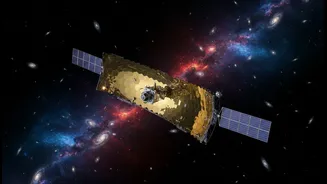
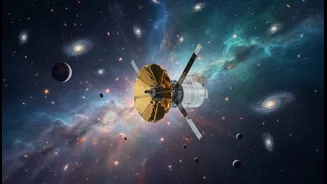
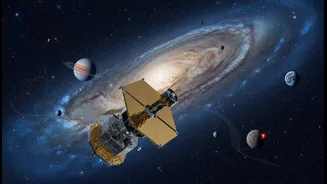
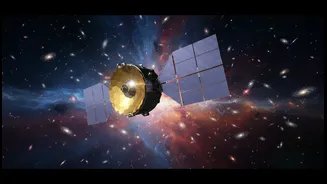
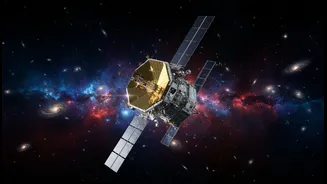
Scheduled to launch in late August 2026, the Nancy Grace Roman Space Telescope is not just another telescope; it's a cosmic surveyor designed for unprecedented scale. While it shares the same 2.4-meter mirror size as the Hubble Space Telescope, its power
lies in its extraordinary field of view. The Wide Field Instrument on Roman can capture a patch of sky more than 100 times larger than Hubble can in a single snapshot, all while maintaining similar image sharpness. This allows it to map vast swathes of the universe at a speed up to 1,000 times faster than Hubble. This capability shifts the mission from focusing on individual cosmic curiosities to creating massive, data-rich maps of the cosmos, enabling astronomers to tackle some of the biggest questions in astrophysics.
Hunting for Dark Matter's Clues
One of Roman's primary targets is the enigmatic substance known as dark matter. While it makes up about 27% of the universe, dark matter is invisible, detectable only by its gravitational influence on the things we can see. Roman will map this unseen matter more precisely than ever before by observing a phenomenon called gravitational lensing. When light from a distant galaxy passes by a massive object (like another galaxy or a clump of dark matter) in the foreground, the gravity of that object bends and magnifies the light. Roman's wide-field surveys are expected to detect tens of thousands of these "lenses." By studying the subtle distortions in the shapes of millions of background galaxies, scientists can create a detailed map of where dark matter is located and learn more about its fundamental nature.
A Census of Alien Worlds
Roman is also poised to be one of history's most prolific planet-hunters. The mission is expected to discover a staggering number of exoplanets—potentially over 100,000 using the transit method alone, where it detects the dimming of a star's light as a planet passes in front of it. But its true game-changer is its microlensing survey. By staring at the dense star fields toward the center of our Milky Way galaxy, Roman will watch for rare events where the gravity of a foreground star and its planets magnify the light of a more distant star. This technique is sensitive enough to find planets with masses as small as Mars and even free-floating "rogue" planets not bound to any star. This will provide a statistical census of planetary systems throughout the galaxy, helping us understand if systems like our own are common or rare.
Mapping the Cosmic Web
Beyond dark matter and exoplanets, Roman will conduct vast galaxy surveys to understand the evolution of the universe. Its High-Latitude Wide-Area Survey will create 3D maps of the universe by measuring the positions and distances of hundreds of millions of galaxies. These maps will reveal the grand-scale structure of the cosmos, often called the "cosmic web," and how it has grown and changed over billions of years. This data is crucial for studying dark energy, the mysterious force causing the expansion of the universe to accelerate. By measuring how galaxy clusters have formed and spread out across different cosmic eras, Roman will test our theories about gravity and provide data on dark energy ten times more precise than current measurements.
Launch vs. Results: A Marathon, Not a Sprint
While the launch in August 2026 will be a monumental achievement, it marks the beginning, not the end, of Roman's journey. After launch, the telescope will travel to its orbit a million miles from Earth, a process that involves commissioning and calibration. The mission's core surveys are designed to run for five years, collecting an immense volume of data that will be released to the scientific community. Finding the answers to questions about dark matter and exoplanet demographics will not come from a single image but from the painstaking analysis of these massive datasets over many years. The discoveries will flow not just from the telescope's hardware in space, but from the software, archives, and follow-up observations by other telescopes on the ground and in orbit.