


The Sun's Final Act
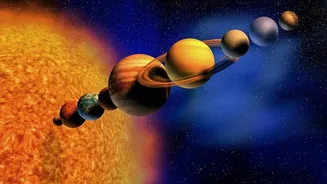
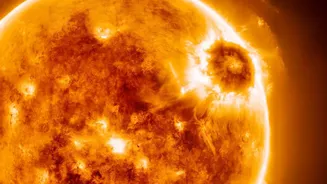
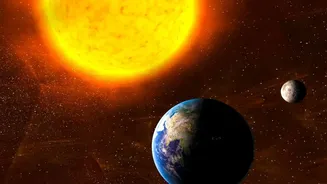
For the past 4.6 billion years, the Sun has been in the stable prime of its life, fusing hydrogen into helium and providing the energy that makes life on Earth possible. But this process won't last forever. In about another 5 billion years, the Sun will
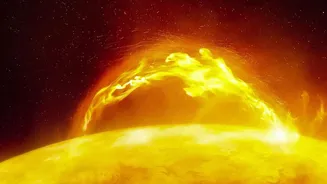
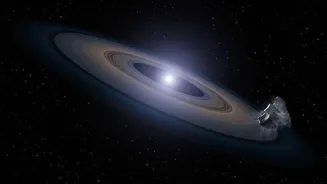
exhaust the hydrogen fuel in its core. Without the outward pressure from fusion, gravity will cause the core to contract and heat up, triggering a new, more violent phase of its life. The star's outer layers will expand dramatically, turning it into a red giant. In this phase, its atmosphere will swell to engulf Mercury and Venus, and quite possibly Earth itself. After this turbulent period, the Sun is expected to shed its outer layers, leaving behind a dense, hot core known as a white dwarf.
Not a Whimper, But a Burst
For decades, scientists largely assumed this mass loss would be a relatively smooth, steady process, like a slow and gentle stellar wind. However, a recent study from astrophysicists at Caltech and the University of Michigan has thrown this peaceful picture into disarray. Their work, published in The Astrophysical Journal Letters, proposes that the Sun won't shed its mass smoothly but in a series of uneven, violent bursts. This idea is based on observations of other white dwarfs, which show small 'kicks' or recoils, suggesting they were pushed by asymmetrical mass ejection. Instead of a gradual release, the Sun will likely throw off its outer envelope in lumpy, energetic parcels, with each burst sending a gravitational jolt through the entire solar system.
Chaos Among the Giants
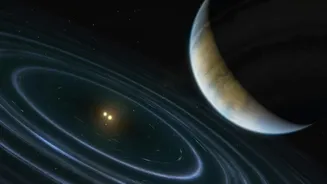
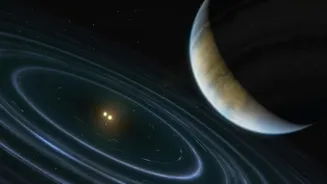
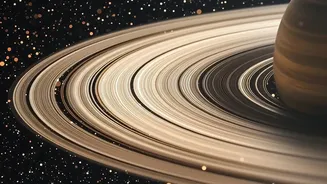
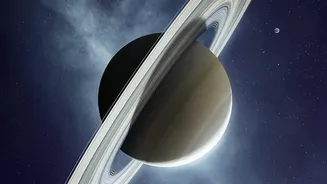
This new model has profound implications for the solar system's survivors: the giant planets. With a smooth mass loss, Jupiter, Saturn, Uranus, and Neptune were predicted to drift into wider, but stable, orbits for potentially a quintillion years. But the simulated bursts of mass create a much more chaotic future. The researchers ran hundreds of simulations, and the results were dramatic. The gravitational nudges from the Sun's violent mass loss can destabilize the carefully balanced orbits of the outer planets. In many scenarios, the disruption began even before the Sun had fully become a white dwarf. The simulations showed planets being thrown into chaotic orbits, with Uranus and Neptune even swapping places in some cases, and others being ejected from the solar system entirely.
A Radically Shorter Timeline
Perhaps the most startling conclusion from the study is the drastically shortened timeline for the solar system's disintegration. Previous models, which factored in the gravitational pull of passing stars, suggested the outer planets could remain in stable orbits for about 100 billion years. The new simulations, focusing on the internal chaos from the Sun's death, shrink that timeline significantly. According to the models that best fit observations, there's a high probability that the outer planets' orbital stability will collapse within just one billion years after the Sun becomes a white dwarf. This rewrites the final chapter of our cosmic neighbourhood, suggesting its end will be driven not by external forces, but by the violent last gasps of its own star.