



A Panoramic View of the Cosmos
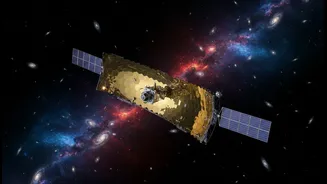
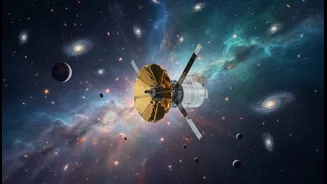
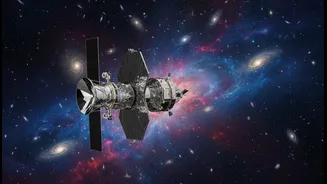
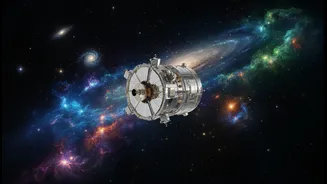
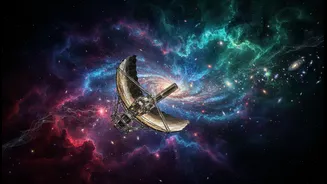
The Nancy Grace Roman Space Telescope is not just another eye on the sky; it's a revolutionary survey mission. While its 2.4-meter primary mirror is the same size as the Hubble Space Telescope's, its power lies in its immense field of view. The Wide Field
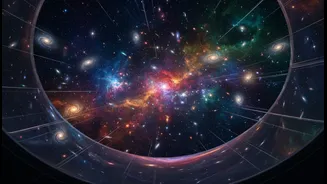
Instrument, Roman's primary camera, can capture an area of the sky at least 100 times larger than Hubble or the James Webb Space Telescope in a single shot. This allows it to map vast cosmic territories with incredible speed and Hubble-like sharpness. Instead of taking detailed snapshots of individual targets like Webb, Roman is designed to create enormous, high-resolution panoramas of the universe, gathering data on billions of objects. This wide-angle, rapid-survey capability is what makes it uniquely suited to address mysteries on a galactic and cosmological scale.
Illuminating Invisible Dark Matter
One of Roman's primary goals is to shed light on something it cannot see: dark matter. This mysterious substance makes up about 27% of the universe but doesn't interact with light, making it invisible. Its presence is only known through its gravitational effects on visible matter. Roman will map the distribution of dark matter by leveraging a phenomenon called gravitational lensing. As light from distant galaxies travels toward us, its path is bent by the gravity of massive objects in the foreground, including clumps of dark matter. Roman's High-Latitude Wide-Area Survey will observe hundreds of millions of galaxies, measuring the subtle distortions in their shapes caused by this weak lensing effect. By analyzing these distortions on a massive scale, scientists will create the most detailed maps ever of where dark matter is and how it has shaped the structure of the universe over billions of years.
A Census of New Worlds
Roman is set to dramatically expand our catalog of planets beyond the solar system. While previous missions like Kepler excelled at finding planets using the transit method (detecting dips in starlight), Roman will primarily use a different technique called gravitational microlensing. This method is sensitive to planets farther from their stars, in orbits similar to those in our own solar system. A microlensing event occurs when a star with a planet passes in front of a more distant star, and its gravity acts as a natural magnifying glass, briefly amplifying the background starlight. The planet's own gravity adds a distinct, smaller spike to this signal. By monitoring hundreds of millions of stars toward the dense center of our galaxy, Roman is expected to find thousands of new exoplanets this way, from small, rocky worlds to ice giants like Neptune. It will even be able to find so-called rogue planets that drift through space without a host star.
Mapping Billions of Galaxies
Beyond dark matter and exoplanets, Roman's surveys will create unprecedented three-dimensional maps of the cosmos. The High-Latitude Wide-Area Survey will capture the positions and distances of billions of galaxies over a huge portion of the sky. This cosmic cartography will help astronomers understand how galaxies form and cluster together into the vast cosmic web. By studying how this structure has evolved over cosmic time, scientists can also probe the nature of dark energy, the enigmatic force causing the universe's expansion to accelerate. Roman's galaxy surveys will provide a dataset of unparalleled size and detail, enabling astronomers to piece together the history of cosmic expansion with much greater precision. These wide-field maps will become a foundational resource for astronomers for decades to come, much like historical sky atlases but on a cosmic scale.