


Meet CHIME, the Universe Mapper
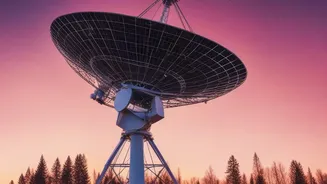
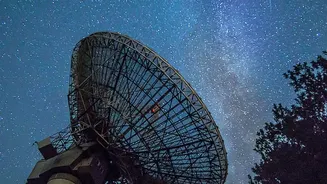
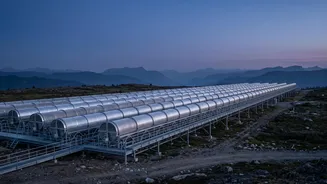
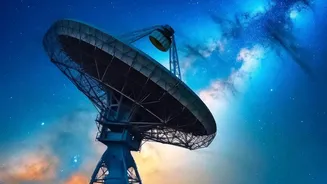
In the mountains of British Columbia, Canada, sits a unique telescope with no moving parts. The Canadian Hydrogen Intensity Mapping Experiment, or CHIME, looks more like a set of four giant metal halfpipes than a traditional observatory. Each day, as
the Earth turns, this stationary instrument scans the entire northern sky, listening for faint radio waves from the cosmos. While CHIME has become famous for detecting mysterious Fast Radio Bursts (FRBs), its primary mission is even more ambitious: to create the largest-volume map of the universe ever made. This map will help scientists tackle one of the biggest puzzles in physics: dark energy, the enigmatic force believed to be causing the universe to expand at an accelerating rate.
The Old Way: A Slow Cosmic Census
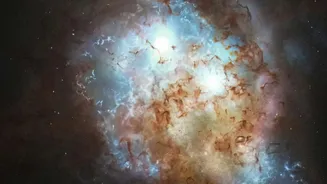
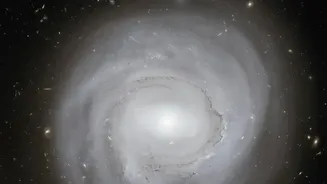
Traditionally, mapping the universe's large-scale structure—the vast 'cosmic web' of galaxies, filaments, and voids—has been a painstaking process. Astronomers would conduct galaxy surveys, pointing powerful optical telescopes at small patches of the sky to identify and measure the distance to individual galaxies one by one. Think of it like trying to create a map of a country by counting every single house. It’s incredibly detailed but also incredibly slow and resource-intensive, costing millions of dollars and many years to cover even a fraction of the sky. While these surveys have been crucial, their pace limits our ability to build the truly enormous maps needed to study the subtle effects of dark energy over cosmic history.
A New Blueprint: Hydrogen Intensity Mapping
CHIME’s approach is fundamentally different. Instead of trying to spot individual galaxies, it employs a technique called 'hydrogen intensity mapping'. It tunes into the faint radio signal emitted by neutral hydrogen, the most abundant element in the universe. This hydrogen gas acts as a tracer, revealing the underlying distribution of all matter. Rather than pinpointing individual points of light (galaxies), CHIME measures the collective glow of hydrogen from enormous volumes of space. It's like looking at a city from a plane at night; instead of counting every streetlight, you see the overall glow of different neighbourhoods, giving you a map of the city’s layout much more quickly. This allows CHIME to build a lower-resolution but vastly larger 3D map of the cosmos, and do so at a fraction of the cost and time of traditional methods.
A Standalone Success
For years, proving this technique could work independently was a major challenge. The hydrogen signal is incredibly faint and easily buried under much louder radio noise from our own galaxy and even human-made sources. Initially, CHIME researchers had to cross-reference their data with optical galaxy surveys to confirm they were seeing a real cosmic signal. But in a milestone achievement, the CHIME collaboration recently announced they had successfully detected the large-scale structure of the universe using only CHIME's own data. By developing sophisticated new processing techniques, they were able to isolate the faint hydrogen glow from when the universe was about five billion years old. This breakthrough proves that intensity mapping is a viable, standalone method for charting the cosmos.
Why This Changes Everything
Mapping the universe without relying on other telescopes is a huge leap forward. It dramatically increases the speed and efficiency of cosmological surveys. With this technique, CHIME and future experiments can map immense volumes of space, reaching further back into cosmic history than was practical before. These enormous 3D maps will allow scientists to measure the 'baryon acoustic oscillations' (BAO)—frozen ripples in the distribution of matter left over from the early universe. By tracking how the size of these ripples has changed over billions of years, astronomers can precisely measure the expansion history of the universe. This provides a powerful tool to test theories about dark energy and gain a deeper understanding of the forces that shape our universe on the grandest scales.