






A High-Speed Cosmic Junkyard
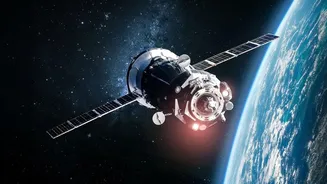
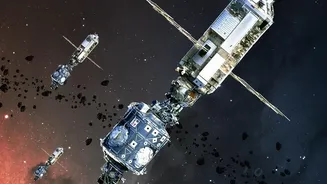
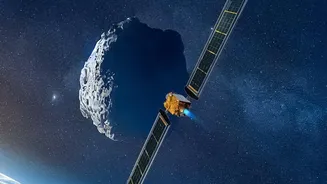
Low Earth Orbit (LEO) is getting dangerously crowded. Decades of space activity have left a legacy of defunct satellites, spent rocket stages, and fragments from past collisions. Experts estimate over a million objects larger than a centimetre are hurtling
around our planet at speeds of up to 28,000 km/h. At that velocity, even a paint chip can inflict catastrophic damage on an active satellite. This growing cloud of space junk poses a significant threat to the operational spacecraft that we rely on for communication, navigation, and weather forecasting. The risk of collision is no longer a distant possibility; ISRO performed 20 collision avoidance manoeuvres in 2025 and nine in the first half of 2026 alone to protect its assets.
India's Critical Eyes in the Sky
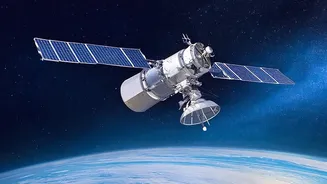
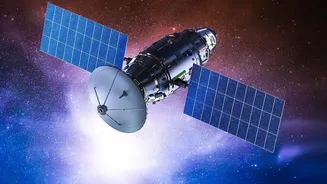
For India, the stakes are incredibly high. The nation operates a sophisticated fleet of Earth-observation satellites that form the backbone of its strategic and civilian infrastructure. These satellites monitor weather patterns, manage agricultural and water resources, aid in urban planning, and provide crucial surveillance for national security. According to recent reports, at least 20 of India's active satellites are in LEO, the orbit most congested with debris. Protecting these multi-crore national assets is not just a technical challenge but a matter of strategic priority. The loss of even one of these satellites could have significant economic and security repercussions.
The Smart Shield: Autonomous Protection
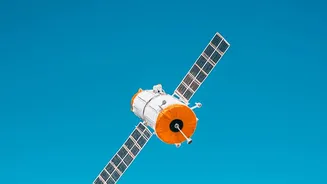
Enter the new era of satellite defence. India is turning to artificial intelligence and advanced propulsion to create a 'smart shield' for its spacecraft. This involves integrating AI-driven software with highly efficient thruster systems. Bengaluru-based startup Bellatrix Aerospace, for example, has developed advanced Hall-effect thrusters. These electric propulsion systems generate thrust by accelerating ionised propellant using electric and magnetic fields, allowing for extremely precise, fuel-efficient adjustments to a satellite's orbit. When paired with AI, these thrusters can execute split-second manoeuvres to dodge incoming threats without waiting for commands from ground control, which can have critical time lags.
How AI Takes the Controls
The integration of AI is the game-changer. Traditionally, collision avoidance was a manual process. Ground stations would track a potential threat, calculate the risk, and then command the satellite to move. This process is slow and resource-intensive. The new approach leverages AI to automate this entire sequence. Systems being developed by Indian space-tech companies can process vast amounts of tracking data from initiatives like ISRO's Project NETRA (Network for space object TRacking and Analysis). The AI algorithms analyse this data to predict collision paths and can then autonomously command the thrusters to fire, nudging the satellite into a safer orbit. This automated decision-making capability eliminates delays, conserves precious fuel, and allows the satellite to protect itself with greater speed and efficiency.
A Leap for India's Space Future
This move towards autonomous protection systems marks a significant step in India's space journey. It aligns perfectly with the goal of 'Aatmanirbhar Bharat' by developing critical, high-end technology domestically. Initiatives like Project NETRA, which aims to give India its own capability in Space Situational Awareness (SSA), are fundamental to this effort. By mastering AI-driven collision avoidance, ISRO not only secures its own assets but also positions India as a responsible space power committed to the long-term sustainability of the orbital environment. This technology also has immense commercial potential, as the demand for protecting satellite mega-constellations from debris grows globally. It is a crucial component of India's ambition to become a leader in space technology and exploration.