



The Cosmic Watering Hole
For as long as we have looked at the stars, we have wondered if Earth is unique. At the heart of that question is water. Life as we know it depends on it, making the search for water a top priority for astronomers. For years, finding liquid water was
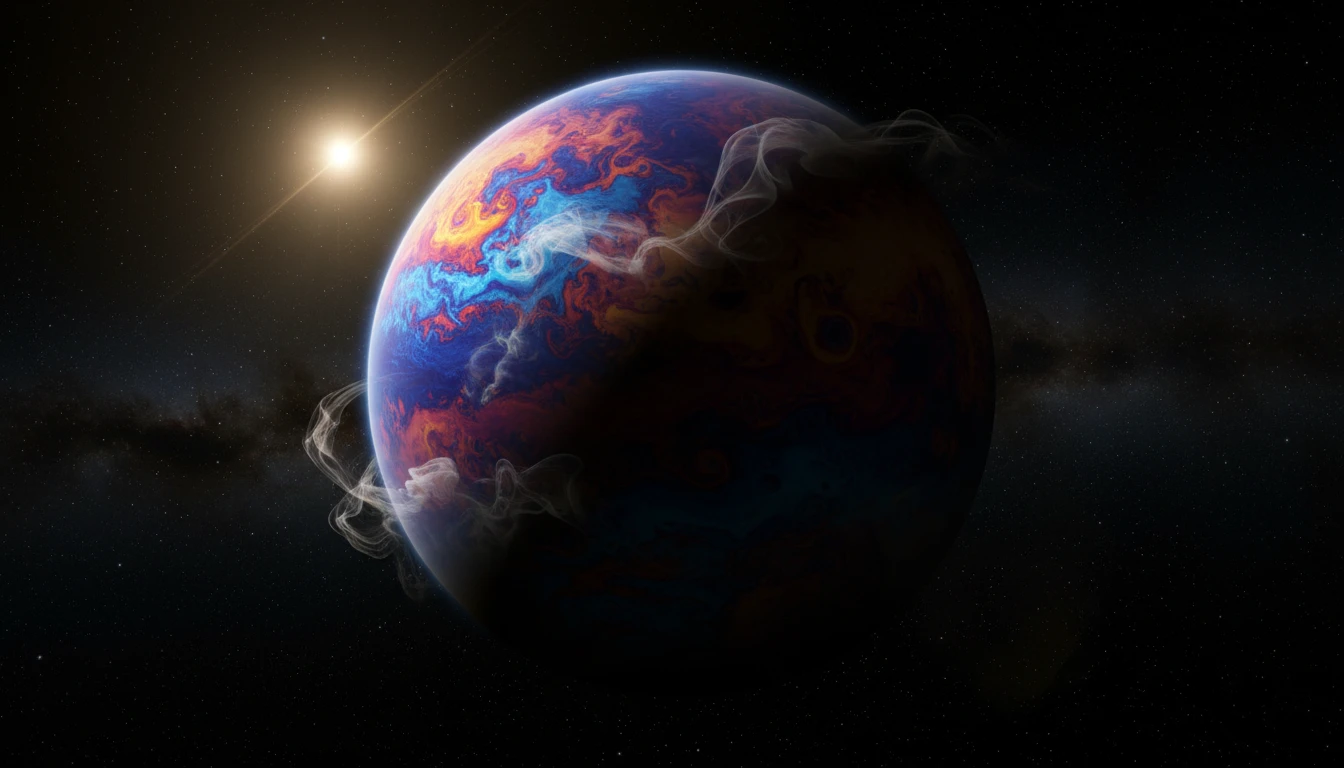
the ultimate goal, but scientists are now realising that its gaseous form, water vapour, might be an even more powerful clue. The recent detection of water vapour in the atmospheres of distant exoplanets is shifting the entire field of planetary science. It’s moving from simply cataloguing planets to truly understanding them.
A New Generation of Vision
This breakthrough has been made possible by a new generation of powerful observatories, most notably the James Webb Space Telescope (JWST). Its incredible sensitivity allows it to do something remarkable. When an exoplanet passes in front of its host star, the telescope can analyse the starlight that filters through the planet's atmosphere. This technique, called transit spectroscopy, allows scientists to see the chemical fingerprints of the molecules present, including the tell-tale signature of water. Before Webb, such detailed measurements were incredibly difficult, especially for smaller, rockier worlds. Now, astronomers can peer into the atmospheres of planets light-years away and start to piece together their composition.
More Than Just Finding H2O
Detecting water vapour isn't just a simple box-ticking exercise. Its presence, or absence, tells a rich story about the planet itself. For instance, in 2023, the JWST detected water vapour in the inner, rocky-planet-forming zone of a young star system called PDS 70. This was a landmark discovery because it showed that the raw materials for water-rich rocky planets, like Earth, are available from the very beginning of a planet's formation. The amount and temperature of water vapour can also provide clues about a planet's temperature, atmospheric pressure, and even its potential for clouds and weather cycles, painting a much more complete picture than just its size and mass.
A New Path for Research
This is the new research path the headline speaks of. Instead of just asking, "Does this planet have water?" scientists can now ask more sophisticated questions. How did the water get there? Did the planet form with it, or was it delivered later by comets and asteroids? For a planet dubbed GJ 9827d, which is about twice Earth's diameter, astronomers are debating two exciting possibilities based on its water-rich atmosphere. It could be a 'mini-Neptune' with a puffy, hydrogen-rich atmosphere, or it could be a 'steam world'—a hot, steamy version of Jupiter's moon Europa. Each possibility tells a different story about the planet's history and formation. This ability to differentiate between formation pathways by analysing atmospheres is a game-changer, moving us into an era of comparative exoplanetology.
From Discovery to Characterisation
Ultimately, detecting water vapour is a crucial stepping stone. It allows scientists to move from the act of discovering a planet to the more nuanced work of characterising it. We are now able to create a far more detailed family album of the thousands of planets discovered across our galaxy. By comparing the atmospheres of these diverse worlds—from gas giants to potential 'super-Earths'—scientists can refine their models of how planetary systems form and evolve. They can start to understand why some planets become scorching, inhospitable worlds while others might develop conditions suitable for life. While the presence of water vapour alone does not mean a planet is habitable, it is a critical piece of the puzzle and the most exciting clue yet in our quest to understand our place in the cosmos.