

A Star's Final Act
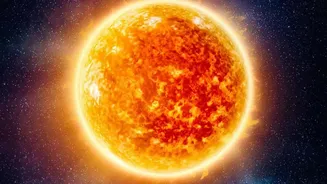
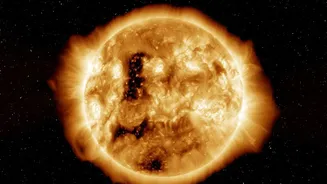
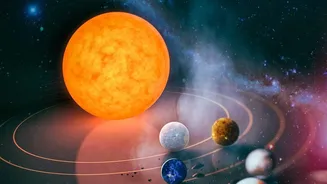
Like all stars, our Sun is a massive nuclear reactor, fusing hydrogen into helium in its core. This process has powered our solar system for about 4.6 billion years. But this fuel is finite. In another five billion years or so, the hydrogen in the Sun's
core will run out. The delicate balance between the outward pressure of fusion and the inward crush of gravity will be broken. Without its main fuel source, the core will contract and heat up, triggering a new phase of fusion in a shell surrounding it. This process will cause the Sun's outer layers to expand dramatically, transforming it into a celestial object known as a red giant.
The Great Expansion
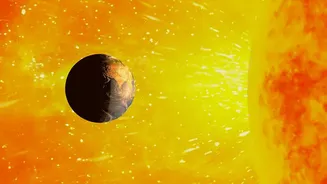
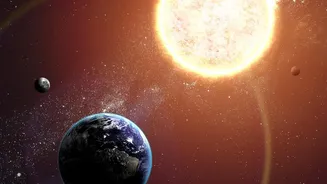
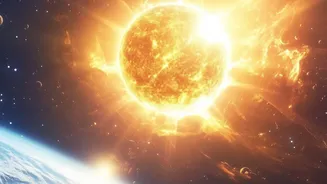
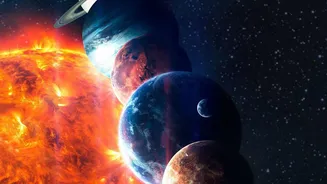
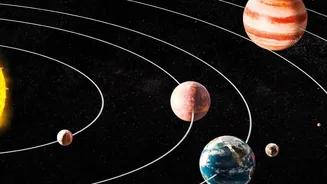
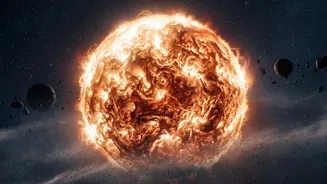
As a red giant, the Sun will swell to hundreds of times its current size. This expansion will be catastrophic for the inner solar system. Mercury and Venus, being the closest planets, will be consumed and vaporized by the Sun's fiery, expanding atmosphere. The fate of Earth hangs in a delicate balance. Some models suggest our planet will be swallowed, while others propose that as the Sun loses mass, its gravitational pull will weaken, allowing Earth's orbit to drift outward to safety. Even if Earth escapes being engulfed, the intense heat will boil away its oceans and atmosphere, rendering it completely uninhabitable. Mars has a better chance of survival, though it too will be scorched.
A New Cosmic Dance
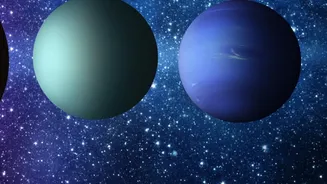
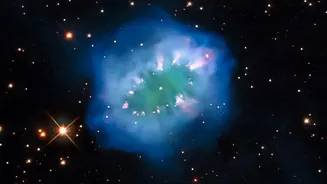
For a long time, astronomers believed the giant outer planets—Jupiter, Saturn, Uranus, and Neptune—would be relatively safe. The prevailing theory was that as the Sun shed about half its mass, the giant planets would simply drift into wider, stable orbits around the resulting white dwarf, the dense stellar core left behind. It was thought this new configuration could last for hundreds of billions of years, until a passing star eventually disrupted the system. However, very recent research paints a much more violent picture. New simulations suggest the Sun won't lose its mass smoothly. Instead, it will happen in powerful, random ejections. These 'stochastic kicks' will nudge the dying Sun, sending gravitational ripples through the solar system that destabilize the giants.
The Solar System's Chaotic End
This new understanding dramatically shortens the lifespan of our solar system. Instead of a tranquil, long-lived system, the final chapter is one of chaos. The gravitational jolts from the Sun's sputtering death could throw the giant planets into disarray far sooner than previously thought—within a billion years after the Sun becomes a white dwarf, not the quintillion years once estimated. Simulations run by researchers show a variety of dramatic outcomes. Planets could be flung out of the solar system entirely, becoming rogue planets wandering interstellar space. In other scenarios, their orbits become so unstable that they cross paths, leading to potential collisions or a gravitational reshuffling where, for example, Uranus and Neptune could swap places. In a significant number of simulations, this instability begins even before the Sun fully becomes a white dwarf, during its chaotic red giant phase.