





The Ultimate Ejector Seat
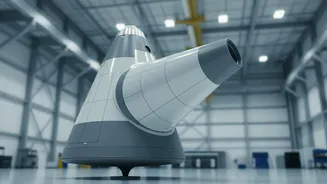
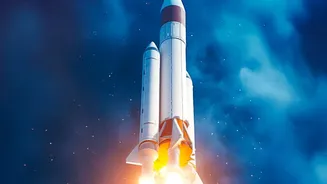
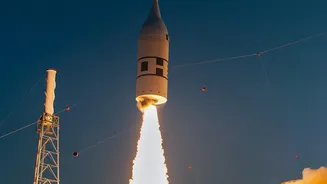
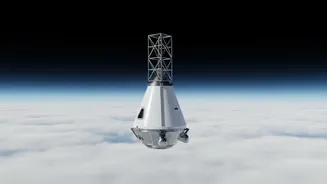
Think of the Crew Escape System (CES) as the most sophisticated ejector seat ever built. It is a dedicated, quick-acting system positioned at the very top of the powerful LVM3 rocket. Its sole purpose is to save the crew in case of a catastrophic failure
during launch or the initial ascent through the atmosphere. Equipped with a cluster of special-purpose solid motors that burn propellant faster and generate more thrust than the main rocket itself, the CES is designed to pull the crew module—the capsule carrying the astronauts—violently away from a malfunctioning vehicle in mere milliseconds. This system is India’s commitment to astronaut safety, a non-negotiable part of its human spaceflight ambitions.
The Challenge of Turbulent Flight
The most dangerous phase of any rocket launch is the initial ascent through the dense lower atmosphere. During this time, the vehicle experiences immense aerodynamic forces, a point known as 'Max Q' or maximum dynamic pressure. The rocket is under incredible stress, pushing against the thick air at supersonic speeds. A failure at this stage is particularly perilous. An abort isn't as simple as just separating. The escape system must not only out-accelerate the failing rocket but also maintain control amidst violent turbulence and high-speed airflow, ensuring the crew module is safely steered away from the debris field of its parent rocket. Testing a system under these chaotic, high-altitude conditions is one of the most complex challenges in human spaceflight engineering.
Simulating Disaster from 3 Kilometres Up
So how does ISRO prove the system works without intentionally blowing up a rocket? Through highly realistic simulations, most notably the Integrated Air Drop Test (IADT). In these carefully orchestrated exercises, a test capsule, precisely matching the weight and dimensions of the final Gaganyaan crew module, is carried to a high altitude by an Indian Air Force Chinook helicopter. Dropped from a height of around 3 kilometres, the module begins a freefall, simulating the conditions of a high-altitude abort scenario. This allows engineers to test the critical deceleration and recovery systems in a controlled but realistic environment, validating everything from parachute deployment to splashdown procedures.
A Perfectly Sequenced Parachute Ballet
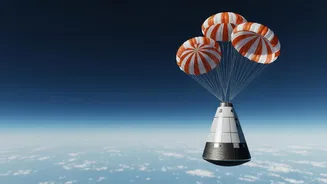
Once the test module is dropped, a complex and precisely timed sequence of events begins automatically. The goal is to safely slow the capsule from high speed to a gentle splashdown velocity. First, smaller drogue parachutes are deployed to stabilize the falling module and reduce its speed. Following this initial deceleration, a set of ten large main parachutes unfurls in a specific sequence. These work together to drastically slow the descent, ensuring the final velocity is a survivable 10-12 metres per second just before it touches the water. Every successful test, like the recent IADT-02, confirms that this multi-stage parachute system works flawlessly, a critical step toward human-rating the entire vehicle.
Data That Builds Confidence
These simulations are more than just visual spectacles; they are massive data-gathering operations. The unpressurised test capsules are fitted with hundreds of sensors that record every aspect of the descent and splashdown. This data provides invaluable real-world information on the performance of the parachute systems, the stability of the module during descent, the forces experienced by the structure, and the accuracy of the splashdown. This information is fed back to refine computer models and confirm that the hardware performs as designed. Each successful test flight, from pad abort tests to these high-altitude drops, validates a different piece of the safety puzzle, building a mountain of evidence that proves the system's reliability and readiness for the ultimate challenge: carrying Indian astronauts.