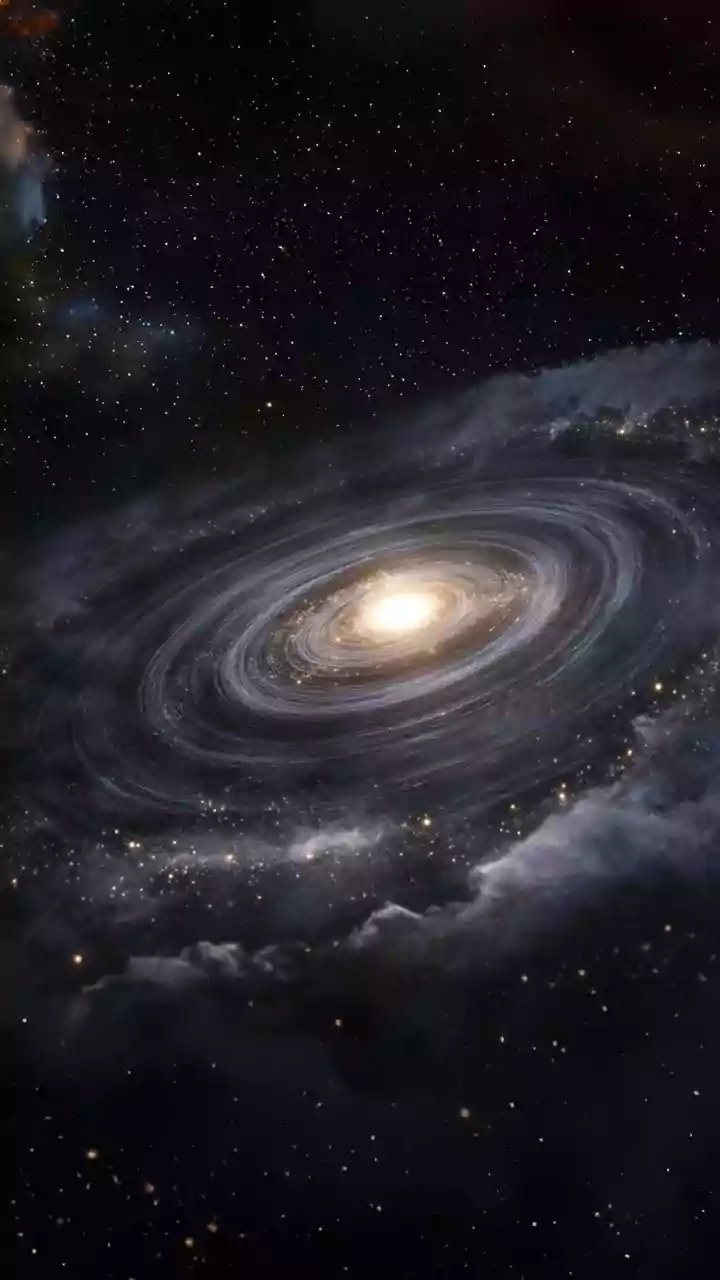


For decades, we’ve been told the universe is about 13.8 billion years old. But what if it’s nearly twice that age? A provocative new theory suggests just that, proposing a 26.7-billion-year timeline that could solve some of cosmology's biggest puzzles.
Our Universe's Standard Age
For most of modern astronomy, the age of the universe has been a settled question. The prevailing theory, known as the Lambda-CDM model, states that everything began with the Big Bang approximately 13.8 billion years ago. Scientists arrived at this number by studying the expansion of the universe—observing how distant galaxies are moving away from us—and by measuring the faint afterglow of the Big Bang, called the cosmic microwave background. This model has been incredibly successful, explaining a wide range of cosmic phenomena. However, it relies on two mysterious components: dark matter and dark energy. These substances have never been directly detected, and together they are thought to make up about 95% of the cosmos, leaving a lot of room for questions.
A Radical New Timeline
Enter a new challenger: the 'Covarying Coupling Constants plus Tired Light' (CCC+TL) model, proposed by University of Ottawa physicist Rajendra Gupta. This model suggests the universe is actually 26.7 billion years old. The idea hinges on two concepts. First, 'tired light', a long-debated theory that photons lose energy as they travel vast cosmic distances. Second, it assumes that the fundamental forces of nature, governed by 'physical constants', might weaken over time. By combining these ideas, Gupta argues that we can explain the universe's observed expansion and structure without needing dark matter or dark energy at all. Instead of dark energy pushing things apart, the weakening forces of nature create a similar effect.
Solving the 'Impossible Galaxy' Problem
A major motivation for this new model comes from recent discoveries by the James Webb Space Telescope (JWST). The powerful telescope has spotted galaxies in the early universe that appear surprisingly mature and massive. Under the standard 13.8-billion-year model, these galaxies would have had very little time to form after the Big Bang, leading some astronomers to call them 'impossible early galaxies'. Gupta's 26.7-billion-year timeline provides a simple solution: these galaxies weren't impossible, they just had much more time to develop. In his model, a galaxy observed at a point when the universe was supposedly just 300 million years old would have actually existed for about 4.6 billion years, plenty of time to grow to its observed size.
The Scrutiny Intensifies
While intriguing, the CCC+TL model is now facing significant scientific pushback. The core concept of 'tired light' has been largely dismissed by physicists for decades because it makes predictions that don't match observations. For example, it fails to explain why images of distant galaxies aren't blurred, and it's inconsistent with observations of the cosmic microwave background. Critics point out that for tired light models to work, they have to be finely tuned, lacking a strong physical motivation. While Gupta's team has published papers showing their model is consistent with some observations like galaxy rotation and the abundance of light elements, other key studies are still under peer review or have been disputed by other research groups.
Science in Action
This debate, however, is not a sign that cosmology is broken. It is a perfect example of the scientific method at work. New, bold ideas are proposed to solve emerging problems, and then the broader scientific community rigorously tests them. The standard Lambda-CDM model remains the best-supported explanation for the universe we see, but its reliance on unseen dark matter and dark energy means scientists are always open to compelling alternatives. The CCC+TL model makes a clear, testable prediction: that JWST should find mature galaxies at even greater distances than it already has. Future observations will either provide strong evidence for this new timeline or reinforce the existing consensus. For now, the 13.8-billion-year-old universe remains the textbook standard, but the conversation is far from over.