






The 'Mechazilla' Dream
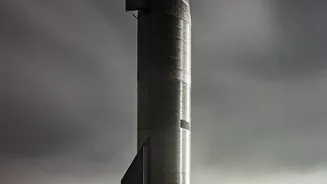
SpaceX's plan for reusing its colossal Super Heavy booster is pure science fiction. Instead of landing on legs like its smaller Falcon 9 sibling, the booster is designed to fly back to its launch site and be caught in mid-air by two huge mechanical arms
on the launch tower, a system unofficially dubbed 'Mechazilla'. This method offers two massive advantages. First, it saves weight. Landing legs for a rocket this size would be incredibly heavy, and every kilogram saved on the booster is a kilogram that can be added to the payload. Second, it dramatically speeds up turnaround time. A caught booster is already positioned at the launch mount, ready to be inspected, stacked with a new Starship upper stage, and potentially reflown in under an hour. This rapid reusability is the key to SpaceX's ambitions for frequent, cost-effective launches.
An All-or-Nothing Gamble
The tower-catch strategy is brilliant, but it's also a high-stakes manoeuvre with very little room for error. The returning booster must execute a series of precise burns to arrive at the tower with near-zero velocity. The tower's arms then have to close at the perfect moment to grab the booster by its structural hard points near the grid fins. A successful catch, first achieved in October 2024, is an immense engineering feat. However, relying solely on this system presents a single point of failure. Any number of issues—a sensor malfunction, a hydraulic problem on the tower arms, or the booster slightly missing its target—could result in a missed catch. If the only option is the tower, a failure doesn't just mean losing a booster; it could mean destroying the launch tower itself, halting the entire launch program for months while repairs are made.
The Return of Landing Legs
This is where the seemingly contradictory decision to add landing legs comes in. These legs are not intended to be the primary landing method. Instead, they serve as a critical backup and a vital part of the system's overall reliability. If an issue prevents a tower catch, the booster could have the option to divert and perform a conventional landing on a solid surface or a droneship. This was part of early Starship design concepts and is now being reintroduced as a contingency. It provides an essential 'plan B'. Rather than an all-or-nothing attempt at the tower, SpaceX is building in redundancy. This suggests a maturing of the Starship program, where the focus is shifting from achieving the ideal outcome to ensuring operational robustness and avoiding catastrophic failures.
A Worthwhile Mass Penalty
The core argument against legs has always been their mass. For a rocket designed to lift over 100 tons to orbit, every gram counts. Adding legs, even lightweight ones, introduces a 'mass penalty' that slightly reduces the rocket's total payload capacity. However, SpaceX is evidently calculating that this penalty is a worthwhile trade-off for the security it provides. The cost of losing a booster is significant, but the cost of losing the entire launch and catch infrastructure would be astronomical. By adding a secondary landing option, SpaceX protects its most valuable ground assets and ensures the program can continue even if a catch attempt is aborted. It's a calculated decision to sacrifice a small amount of payload performance for a massive gain in operational resilience.
A Stepping Stone to Mars and Beyond
This dual-capability approach also opens up future possibilities. While the tower catch is perfect for the high-cadence launch-and-relaunch cycle at established spaceports like Starbase, landing legs are essential for missions to the Moon and Mars, where there won't be a 'Mechazilla' tower waiting. Early Starship prototypes used legs for their test flights, and developing a robust leg system for the final vehicle is a necessary step for extraterrestrial landings. Therefore, incorporating legs on the Super Heavy booster isn't just about contingency on Earth; it's about developing and proving the hardware that will eventually be needed to land on other worlds. This makes the addition of legs less of a step backward and more of a parallel development path, ensuring the Starship system is flexible enough for all its future roles.