






The Growing Problem of Skyglow
For most of us living in or near cities, the night sky is no longer black but a hazy, orange-grey canvas where only the brightest stars are visible. This phenomenon, called 'skyglow', is a form of light pollution. It happens when artificial light from
streetlights, buildings, and vehicles escapes upward and scatters off particles in the atmosphere, creating a dome of light that can be seen from hundreds of kilometres away. This not only robs us of our cosmic view but also wastes energy and disrupts ecosystems that depend on darkness. While cities like Delhi and Bangalore see their skies brightening by the year, a few places remain untouched.
Spiti's Unique Geographic Position
Spiti Valley's secret lies in its exceptional geography. Located in the north-eastern part of Himachal Pradesh, it's a cold desert mountain valley with an average elevation of over 12,500 feet. The name 'Spiti' itself means 'The Middle Land', a reference to its location between India and Tibet, surrounded by towering Himalayan ranges. Crucially, it sits in a rain shadow of the main Himalayan range. This means the massive mountains block most of the monsoon clouds, resulting in an arid climate with very low humidity and over 250 clear nights a year. The air is thin, dry, and exceptionally clear, a perfect recipe for stargazing.
The Great Himalayan Shield
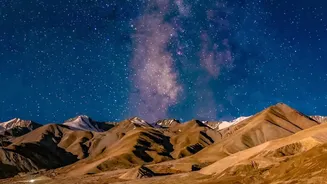
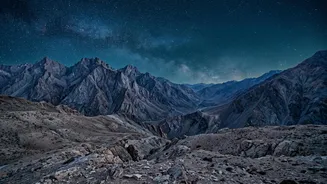
The very mountains that define Spiti's landscape are its greatest defenders against light pollution. The valley is enclosed by colossal peaks, including the Kunzum range, which separates it from Lahaul and Kullu. These formidable physical barriers, often rising above 6,000 metres, act as a natural shield. They physically block the faint, scattered light—the skyglow—emanating from distant urban centres in the Indian plains. While light can travel vast distances, it cannot pass through a mountain. The sheer scale and elevation of the Himalayas effectively isolate the valley, creating a pocket of profound darkness that is almost impossible to find elsewhere.
A Sanctuary for Stargazers
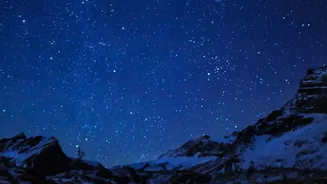
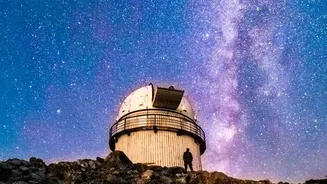
This combination of high altitude, dry air, and a mountain shield makes Spiti a world-class destination for astronomy. Its skies are rated Bortle Class 1-2, the darkest possible classification, a quality shared by professional observatory sites like Hanle in Ladakh. In villages like Langza, Komic, and Kibber, all situated above 4,200 metres, the Milky Way is so bright it can cast a faint shadow on moonless nights. The Andromeda Galaxy is visible to the naked eye, and constellations appear dense with stars, burning steadily in the thin, stable air. This natural advantage has turned the valley into a hub for astro-tourism, with guided stargazing sessions and astrophotography workshops becoming a key part of the local economy.
Protecting a Precious Resource
While Spiti is naturally shielded from distant threats, its pristine skies are not entirely immune. The growing popularity of tourism brings the risk of local light pollution. Even minimal, poorly designed lighting in villages and campsites can degrade the very darkness that makes the region special. Recognizing this, there is a growing movement to preserve Spiti's cosmic heritage. Initiatives to train local guides in astronomy and promote responsible lighting practices are taking root. Some have even identified Spiti as a potential Dark Sky Reserve, a designation that would provide a framework for its long-term protection. For now, the valley remains a breathtaking window into the universe, a gift of its unique high-desert topography.