





The Sun’s Violent Outbursts
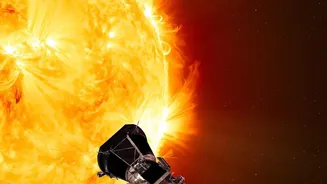
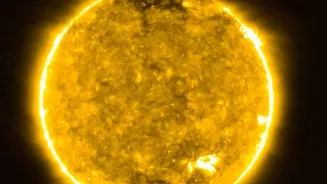
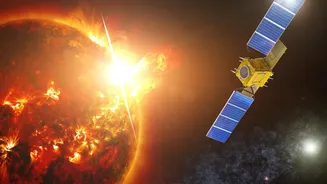
The Sun, while a source of life, is not always calm. It periodically releases immense bursts of energy and particles. These events come in two main forms: solar flares and Coronal Mass Ejections (CMEs). A solar flare is an intense flash of radiation,
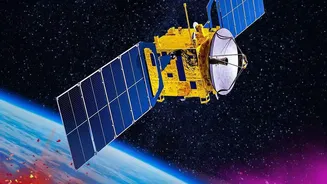
while a CME is a massive explosion of plasma and magnetic fields from the Sun's outer atmosphere, the corona. While both can be disruptive, CMEs are often considered more hazardous to our technology. These clouds of charged particles travel through space, and when they collide with Earth, they can wreak havoc on our technological infrastructure. The high-energy particles can penetrate and damage sensitive satellite electronics, cause radio blackouts, and even induce currents in ground-based power grids, leading to widespread outages.
Eyes on the Sky
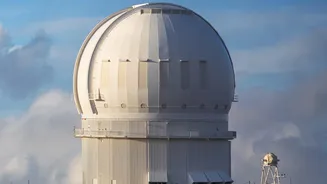
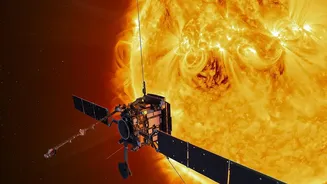
To protect against this threat, a global network of observatories keeps a constant watch on the Sun. This network includes both ground-based telescopes and space-based satellites. Ground observatories, while affected by weather and Earth's atmosphere, play a crucial role. One such important facility in India is the Udaipur Solar Observatory (USO), managed by the Physical Research Laboratory. Its location on an island in Lake Fatehsagar minimises atmospheric turbulence, allowing for clearer images of the Sun's surface. These observatories use specialised telescopes, like the Multi-Application Solar Telescope (MAST) at USO, to monitor the Sun's magnetic fields and track the development of active regions where flares and CMEs are born.
The Critical Need for Speed
When a CME erupts, one of the most critical factors to determine is its speed. The velocity of the particle cloud dictates how much time we have to prepare. Slower CMEs might take several days to reach Earth, while the fastest can arrive in under 24 hours. Observatories track the eruption's progress across the Sun's disc and as it travels into space. Instruments called coronagraphs block out the Sun's bright face, allowing scientists to see the much fainter corona and track the CME as it expands outwards. By analysing a sequence of these images, researchers can calculate the speed and trajectory of the CME, predicting if it's heading towards Earth and when it will arrive.
From Warning to Action
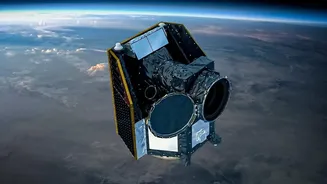
This data on speed and direction is fed into space weather prediction models. Agencies like NOAA's Space Weather Prediction Center (SWPC) and Indian centres processing data from missions like Aditya-L1 issue alerts based on these forecasts. These warnings are crucial for satellite operators. With enough lead time, they can take protective measures to minimise damage. A common strategy is to put satellites into a 'safe mode', temporarily shutting down non-essential and vulnerable electronic systems until the storm passes. They can also reorient satellites to shield sensitive components or, for those in low-Earth orbit, adjust their altitude to counteract the increased atmospheric drag caused by the storm.
India’s Growing Role in Solar Sentry
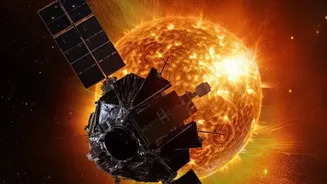
India has significantly enhanced its capabilities in space weather monitoring and forecasting. The nation's ground-based observatories, like those in Udaipur and Kodaikanal, form a vital link in the global chain of solar observation, filling a longitudinal gap between Australia and Spain. This effort is complemented by ISRO's Aditya-L1 mission, India’s first dedicated solar observatory in space. Positioned at the L1 Lagrange point, it gets an uninterrupted view of the Sun and can detect the solar wind and CMEs before they reach Earth, providing a vital early warning of 30-60 minutes. The data from Aditya-L1, combined with information from ground facilities like the Indian Network for Space Weather Impact Monitoring (INSWIM), creates a comprehensive system to protect the nation's critical space and ground infrastructure.