





An Unplanned Lunar Encounter
The object expected to collide with the Moon today is not a rogue asteroid, but rather a piece of space junk. Specifically, it is the upper stage of a SpaceX Falcon 9 rocket that launched in January 2025. After deploying its payload for a lunar mission,
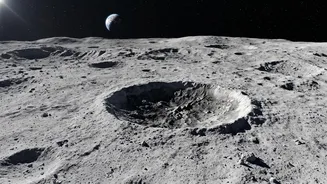
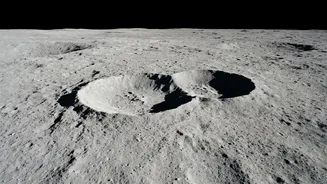
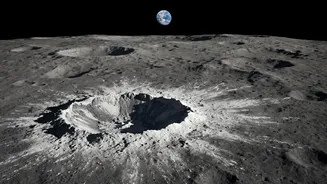
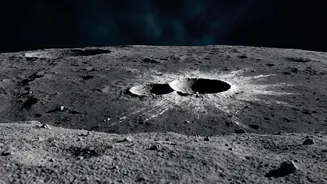
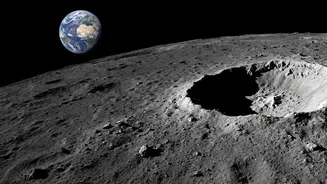
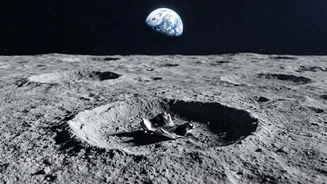
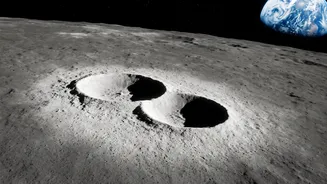
the spent stage was left in an uncontrolled orbit. Independent astronomer Bill Gray first calculated that its long, looping journey would end with it slamming into the Moon on August 5, 2026. The object, weighing around four tonnes and travelling at over 8,700 kph, is expected to create a new crater near the Moon's western limb. While the event is notable, it poses absolutely no danger to us on Earth.
Why Scientists Are Watching Closely
While the impact is accidental, it presents a valuable, unplanned experiment for planetary scientists. Observing the collision provides a rare chance to study impact physics in real-time. When the rocket stage hits the surface, it will blast a plume of lunar dust and rock, known as regolith, high above the surface. Scientists hope to analyze this ejected material using orbiting spacecraft like NASA's Lunar Reconnaissance Orbiter and Earth-based telescopes. This can reveal new details about the Moon's composition, particularly in a region that hasn't been directly sampled. Though the impact itself won't be visible from Earth, there's a small chance the debris cloud could be seen for a few minutes with powerful telescopes, especially for observers in the Americas.
The Real-Life Asteroid Hunters
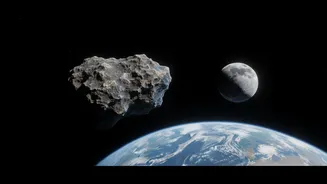
This man-made impact is a world away from the serious business of planetary defense. The real threat comes from natural Near-Earth Objects (NEOs)—asteroids and comets whose orbits bring them close to Earth. To handle this, NASA established the Planetary Defense Coordination Office (PDCO). This office oversees all NASA-funded projects to find, track, and characterize potentially hazardous objects. Their goal is to identify at least 90 percent of NEOs larger than 140 meters—the size that could cause regional devastation. Working with global partners, the PDCO is the central hub for assessing threats and coordinating a response if a dangerous object is ever found.
The Science of Seeing the Future
Predicting an impact is a meticulous, multi-step process. It begins with discovery, usually by wide-field survey telescopes that scan the sky for moving objects. Once a new NEO is spotted, astronomers take follow-up observations to calculate a preliminary orbit. This initial path has a lot of uncertainty. To reflect this, scientists map out a cloud of possible orbits within an 'error ellipse'. As more observations are made over days, weeks, and months, the orbit becomes more defined, and the error ellipse shrinks. To do these complex calculations, NASA's Center for Near-Earth Object Studies (CNEOS) uses a powerful system called Sentry-II, which can rapidly assess impact probabilities for decades into the future.
Decoding the Threat Level: The Torino Scale
To communicate risk without causing undue panic, scientists use the Torino Scale. It’s a simple 0-to-10 rating system that combines impact probability with the potential for destruction. A '0' (color-coded white) means an object has a negligible chance of impact or is too small to cause damage. A '1' (green) signifies a routine discovery that merits monitoring but is no cause for public concern. Levels 8, 9, and 10 (red) are reserved for certain collisions, with the severity ranging from localized to global catastrophe. Crucially, nearly all new discoveries are eventually downgraded to a 0 as more data confirms they will miss Earth. To date, no object has ever been rated higher than a 4, and that was only briefly before it, too, was re-assigned to Level 0.