



From Cane to Crystal: A Tale of Two Processes
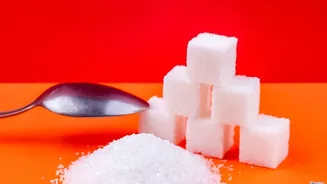
The fundamental difference between jaggery and sugar lies in how they are made. Both begin their journey as juice extracted from sugarcane. For white sugar, this juice undergoes intensive, multi-step refining. It is clarified, filtered, and crystallised
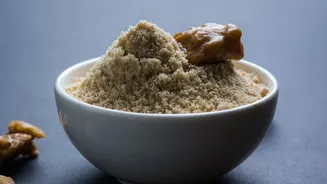
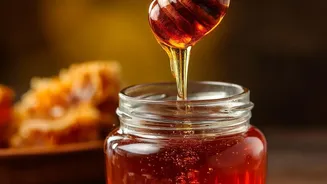
to isolate the pure sucrose, stripping away virtually all other components. The result is the uniform white crystal we know. Jaggery, on the other hand, is produced through a much simpler, traditional method. The sugarcane juice is boiled in large, open pans until it thickens and solidifies. Because it is unrefined, it retains the molasses, a nutrient-rich byproduct that is removed from white sugar. This lack of processing is what gives jaggery its characteristic golden-to-dark-brown colour and its complex, caramel-like flavour.
The Nutritional Showdown: More Than Just Sweetness?
Because jaggery retains molasses, it contains trace minerals that are absent in 'empty calorie' white sugar. Jaggery provides small amounts of iron, magnesium, potassium, and calcium. For example, 100 grams of jaggery can contain a significant amount of iron. However, it is crucial to consider portion sizes. A typical serving is closer to 10-15 grams, not 100. At this realistic amount, the mineral contribution is quite small and not enough to meet daily requirements. Calorie-wise, there is almost no difference; both provide about 380-390 calories per 100 grams. So while jaggery is nutritionally superior on paper, the practical benefit from its mineral content is marginal unless consumed in very large, unhealthy quantities.
The Blood Sugar Spike: A Surprising Twist
Many people believe jaggery is safer for blood sugar because it is 'natural'. However, this is a dangerous misconception, especially for individuals with diabetes. The Glycemic Index (GI), which measures how quickly a food raises blood glucose, reveals a surprising fact. Most sources indicate that sugarcane jaggery has a high GI, often around 84, which is even higher than that of white sugar (around 65). This means jaggery can cause a faster and sharper spike in blood sugar levels. While some suggest its complex sucrose structure leads to slower digestion, the high GI data contradicts this. For anyone managing diabetes or insulin resistance, both sweeteners should be treated with equal caution and consumed in strict moderation, if at all.
The Winter Connection: Why Gur Shines in the Cold
Jaggery's popularity soars in winter for reasons rooted in tradition and Ayurvedic wisdom. It is considered a 'warming' food (having a hot 'tasir'), believed to help the body generate heat and sustain itself against the cold. This is why it is a staple ingredient in winter delicacies like chikki, gajak, and ladoos, often combined with other warming ingredients like sesame seeds, peanuts, and ghee. Traditionally, a small piece of jaggery is consumed after meals to aid digestion by stimulating digestive enzymes. It's also a common home remedy for coughs and colds, believed to help soothe the respiratory tract. This cultural role as a comforting, warming, and functional food is central to jaggery's winter appeal.
The Final Verdict: A Matter of Moderation
So, should you throw out your sugar and switch entirely to jaggery? Not so fast. Jaggery is the marginally better choice because it is less processed and contains a few extra nutrients. Its rich flavour adds depth to traditional sweets and beverages that white sugar cannot match. However, it is crucial to remember that jaggery is, at its core, a sugar. It is high in calories and has a significant, often rapid, impact on blood sugar levels. The headline says it best: both sweeteners contribute sugar and energy. The real health win does not come from choosing one over the other, but from reducing the overall intake of all added sweeteners. When you do indulge, choosing jaggery gives you a slight nutritional edge and a connection to a rich culinary tradition, but moderation remains the most important ingredient.