




The Coolest Science in the Solar System
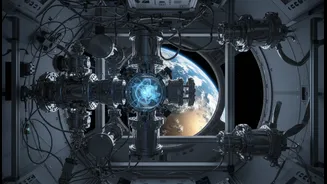
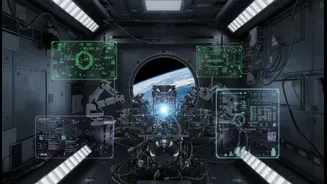
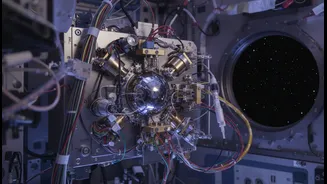
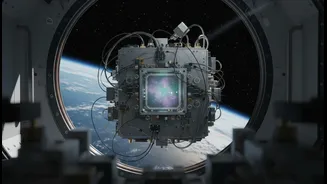
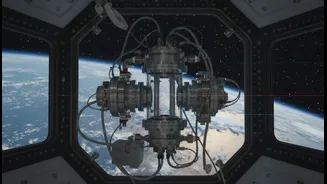
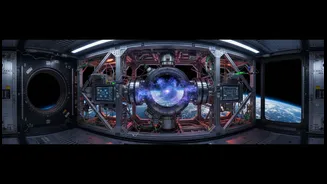
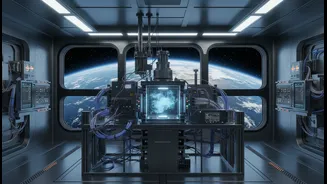
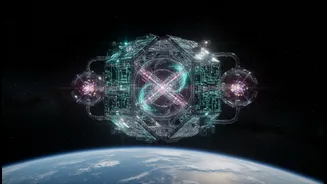
Aboard the International Space Station (ISS), an instrument called the Cold Atom Lab (CAL) is creating the coldest known conditions in the universe. Since its installation in 2018, this facility has allowed scientists, operating it remotely from Earth,
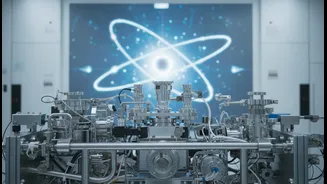
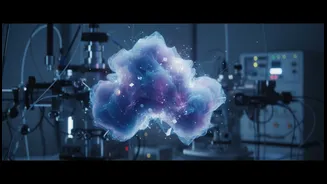
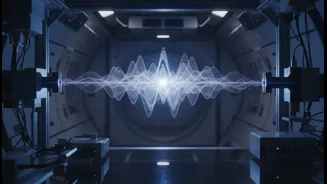
to cool clouds of atoms like rubidium and potassium to temperatures just fractions of a degree above absolute zero (minus 273.15 degrees Celsius). At these extreme temperatures, something incredible happens: the atoms slow to a near standstill and begin to behave not as individual particles but as a single, collective quantum wave. This exotic state is known as a Bose-Einstein Condensate (BEC), sometimes called the fifth state of matter. The microgravity of the ISS is the crucial ingredient, allowing scientists to observe these fragile quantum phenomena for much longer durations than is possible on Earth, where gravity quickly pulls the atoms apart.
A Quantum Leap in Understanding
By forming BECs in orbit, the Cold Atom Lab provides a unique window into the strange rules of quantum mechanics. Normally, quantum effects like superposition (where a particle exists in multiple places at once) are confined to the subatomic realm. In a BEC, these behaviors become macroscopic, meaning they are large enough to be studied in detail. Recent upgrades to the facility in 2026 have further enhanced its capabilities, allowing for the creation of larger condensates and providing more flexibility for experiments. This fundamental research is not just an academic exercise; it's about probing the very nature of matter and energy, which could lead to answers about cosmological mysteries like dark matter and dark energy. Scientists are using tools called atom interferometers within the CAL to perform these trailblazing experiments, demonstrating that such sensitive equipment can operate reliably in space.
The Promise: A Revolution in Sensing
The true promise of the Cold Atom Lab lies in its potential to revolutionize precision sensing technology. The extreme sensitivity of ultracold atoms to their surroundings makes them ideal for building next-generation sensors. These quantum sensors could lead to atomic clocks of unprecedented accuracy, essential for GPS and financial networks. They could also enable navigation systems that don't rely on GPS signals, a critical capability for defense, aerospace, and even autonomous vehicles in areas where satellite signals are unavailable. Furthermore, these sensors could detect minute variations in gravity, allowing for detailed mapping of resources beneath the Earth's surface, monitoring water tables, or giving early warnings of volcanic activity. In essence, the physics being perfected on the ISS could form the bedrock of technologies that see the invisible and measure the imperceptible.
The Reality: From Orbit to Industry
Herein lies the critical distinction. While the science is groundbreaking, translating these orbital experiments into commercial products is a monumental challenge. The Cold Atom Lab is a highly specialized, minifridge-sized facility requiring immense power and a unique microgravity environment. Quantum sensors are notoriously fragile; their extreme sensitivity is also their greatest weakness, as they are easily disrupted by vibrations, temperature changes, and electromagnetic interference. The process of miniaturizing this complex hardware, making it rugged enough for use on a moving vehicle or in a handheld device, and making it cost-effective is a journey measured in decades, not years. As with technologies like lasers and GPS, there is a long and arduous path from laboratory proof-of-concept to widespread, practical deployment.