








The Hum of Spacetime
Let's be clear: this isn't sound in the way we experience it on Earth. Sound needs a medium, like air or water, to travel, and space is a near-perfect vacuum. The "sound" scientists are talking about is far more fundamental: it's the faint, constant vibration
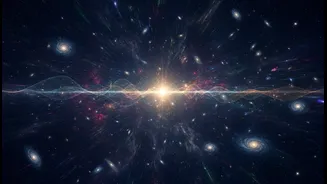
of spacetime itself. These vibrations are called gravitational waves. Predicted by Albert Einstein a century ago, gravitational waves are ripples in the fabric of the universe, created by the movement of immensely heavy objects. Until 2015, their detection was indirect. But now, we've moved from catching fleeting chirps from single events, like two black holes colliding, to hearing a persistent, low-frequency background hum. This is the collective roar of cosmic giants across the universe, a 'sound' that has been travelling for billions of years.
An Orchestra of Pulsars
So how do you listen to the hum of the universe? You can't build a microphone big enough. Instead, scientists came up with a brilliantly creative solution: a galaxy-sized gravitational wave detector. They formed what is called a Pulsar Timing Array (PTA). This involves monitoring dozens of pulsars, which are incredibly dense, rapidly spinning dead stars. These cosmic lighthouses send out beams of radio waves at extraordinarily regular intervals. Their pulse is so predictable they function like the most accurate clocks in the universe. By timing the arrival of these pulses on Earth with immense precision, scientists can detect tiny, correlated delays. A passing gravitational wave stretches and squeezes the spacetime between us and the pulsar, causing its pulse to arrive a few nanoseconds early or late. After monitoring dozens of pulsars for over 15 years, researchers could finally distinguish the specific pattern that signals a background of gravitational waves.
India Joins the Chorus
This monumental discovery is the result of a global collaboration, with India playing a key role. The Indian Pulsar Timing Array (InPTA) collaboration, using the upgraded Giant Metrewave Radio Telescope (uGMRT) near Pune, is a vital part of the worldwide effort. InPTA's high-quality data was included in the analysis by the European Pulsar Timing Array (EPTA), contributing to the first evidence of this gravitational wave background. With its unique observational capabilities, the Pune-based GMRT helps make the global detector more sensitive. The recent second data release from InPTA, spanning over seven years of observations, marks a major milestone, strengthening India's position at the forefront of this new field of astronomy and contributing significantly to the International Pulsar Timing Array's (IPTA) global search.
The Sound of Black Holes Merging
What is making all this noise? The prime suspect is the slow, cosmic waltz of supermassive black holes. These are the behemoths that sit at the centre of most galaxies, weighing millions or even billions of times more than our sun. When galaxies collide and merge—a common event in cosmic history—their central black holes are drawn into a ponderous, centuries-long orbit around each other before finally coalescing. It is the sum of all these titanic pairings across the universe that is thought to generate the constant, low-frequency hum that Pulsar Timing Arrays are now detecting. We are, in effect, hearing the background music of galaxy formation itself.
A New Sense for Astronomy
For centuries, our understanding of the universe came from looking at it—studying light in all its forms, from radio waves to gamma rays. The detection of high-frequency gravitational waves in 2015 gave us a new sense. Now, the discovery of this low-frequency background noise is like that sense maturing. It is the difference between hearing a single, loud cymbal crash and being able to appreciate the entire bass section of an orchestra. This new 'auditory' window allows us to probe some of the deepest mysteries in cosmology: how the largest structures in the universe form, how supermassive black holes grow, and it may even reveal exotic new physics from the very dawn of time. By adding sound to the cosmic movie, we are just beginning to understand the full story.