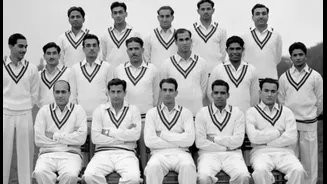








A Tradition Born from Class and Courtesy
The tradition of wearing white dates back to the 1800s when cricket was a game for the English gentry. In that era, wearing white was a sign of social status; it was expensive and difficult to keep clean, subtly broadcasting wealth and a leisurely lifestyle.
The all-white attire also lent a sense of order and respectability to the game, fitting for an activity considered a “gentleman’s game.” The first-ever Test match in 1877 saw both England and Australia take the field in white, cementing a tradition that has lasted for over a century. This historical context established whites as the uniform of cricket's most prestigious format, a nod to its origins and heritage.
The Simple Science of Staying Cool
Beyond tradition, there is a crucial practical reason for wearing white: temperature regulation. Test matches are played over five days, often under a blazing sun for hours at a time. Basic physics tells us that white-coloured clothing is a superior reflector of sunlight, absorbing less heat compared to darker colours. This helps players stay cooler and reduces the risk of dehydration and heatstroke during long stints on the field. While some modern studies suggest the looseness of clothing is more critical for airflow, the heat-reflecting property of white fabric remains a significant advantage in a sport that demands peak physical endurance for days on end.
Making the Red Ball Pop
Another key functional aspect of the white uniform is visibility. For decades, Test cricket was played exclusively with a dark red ball. Against the backdrop of an all-white kit, the red ball stands out far more clearly for batsmen, fielders, and even umpires. This contrast is vital for a batsman facing a delivery at speeds exceeding 140 km/h or a fielder trying to catch a fast-moving ball from a distance. Even for spectators, especially before the era of high-definition television, white uniforms made it easier to follow the players and the ball against the green outfield.
A Symbol of Purity and Discipline
Over time, the white uniform has taken on a powerful symbolic meaning. It represents the purity and discipline of Test cricket, which is often called the truest and most challenging format of the game. Unlike the colourful, sponsor-heavy kits of limited-overs cricket, the clean slate of the whites puts the focus squarely on the skill, patience, and strategy of the players. It acts as a great leveller; on the field, every player is equal, distinguished only by their performance, not by flashy attire. The International Cricket Council (ICC) enforces this with strict regulations, mandating that Test attire must be predominantly white or cream, with only minimal coloured trim allowed.
The Revolution of Colour
The enduring presence of whites in Tests is made even more distinct by the explosion of colour in other formats. Coloured clothing was revolutionarily introduced in Kerry Packer's World Series Cricket in the late 1970s, primarily for day-night matches where a white ball was used against coloured kits for better television visibility. This innovation was widely adopted and made its global debut at the 1992 World Cup. The commercial success and fan appeal of coloured jerseys cemented their place in One Day Internationals (ODIs) and T20s, turning them into a vibrant spectacle. This contrast only serves to elevate the status of the Test whites, marking the five-day game as a unique event that honours its deep-rooted history.