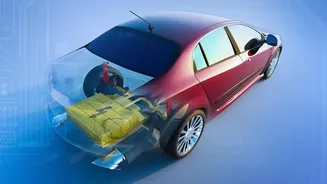








What Exactly Is a Solid-State Battery?
At its core, a battery works by moving ions between a negative side (anode) and a positive side (cathode) through a medium called an electrolyte. In the lithium-ion batteries that power nearly all of today's EVs and smartphones, this electrolyte is a flammable
liquid or gel. A solid-state battery, as the name implies, replaces this liquid with a solid material, often a ceramic or polymer compound. This fundamental change might seem small, but it has massive consequences for performance and safety. Think of it as swapping out a water-filled sponge for a solid, dense block that does the same job more efficiently and without the risk of leaks or fire.
The Promise: More Kilometres, Less Worry
The two biggest advantages touted for solid-state technology are higher energy density and vastly improved safety. Higher energy density means the battery can store more energy in the same amount of space. For an EV driver, this translates directly into a longer driving range, tackling the infamous 'range anxiety' that holds many potential buyers back. It could allow cars to travel significantly further on a single charge or enable manufacturers to use smaller, lighter battery packs without sacrificing range. Furthermore, some research suggests solid-state designs could allow for ultra-fast charging, with prototypes reaching 80% charge in minutes.
A Fundamental Leap in Safety
Safety is a major selling point. By eliminating the flammable liquid electrolyte found in conventional lithium-ion batteries, solid-state designs dramatically reduce the risk of thermal runaway—a dangerous chain reaction that can lead to fires. The solid structure is also more resistant to the formation of dendrites, which are tiny, needle-like structures that can grow inside liquid-based batteries and cause short circuits. This inherent stability makes them safer to operate, especially in India's diverse and often hot climate, where battery heat management is a critical concern.
The Reality Check: Hurdles on the Road to Mass Adoption
Despite the immense promise, solid-state batteries are not ready for primetime just yet. The key challenges are cost and manufacturing complexity. The materials are expensive, and the production processes are still being perfected, making them far from commercially viable for the mass market. Automakers like Toyota and Nissan are targeting small-scale production around 2027-2028, but widespread availability in affordable vehicles is likely still a decade away. Until these manufacturing hurdles are overcome, conventional lithium-ion batteries, especially the increasingly popular and safer Lithium Iron Phosphate (LFP) variety, will continue to dominate the EV market.
What's Happening in India?
India is not sitting on the sidelines. Recognizing the strategic importance of battery technology, several Indian companies and research institutions are actively engaged in development. Companies like Ola Electric have announced plans for a gigafactory with a focus on solid-state cells, while Vikram Solar is also venturing into manufacturing. Academic institutions like IIT Roorkee are conducting advanced research into solid electrolytes. Start-ups such as GODI and Gegadyne Energy are also pushing innovation in the space. This local push is crucial for India to reduce its reliance on imported battery cells and technology, which currently make up a significant portion of an EV's cost, and to build a self-reliant EV ecosystem.