


A Journey Back in Time
The universe is so vast that light, even travelling at its incredible speed of nearly 300,000 kilometres per second, takes a very long time to cross it. When we look at the Sun, we are seeing it as it was eight minutes ago. When we see the Andromeda Galaxy,
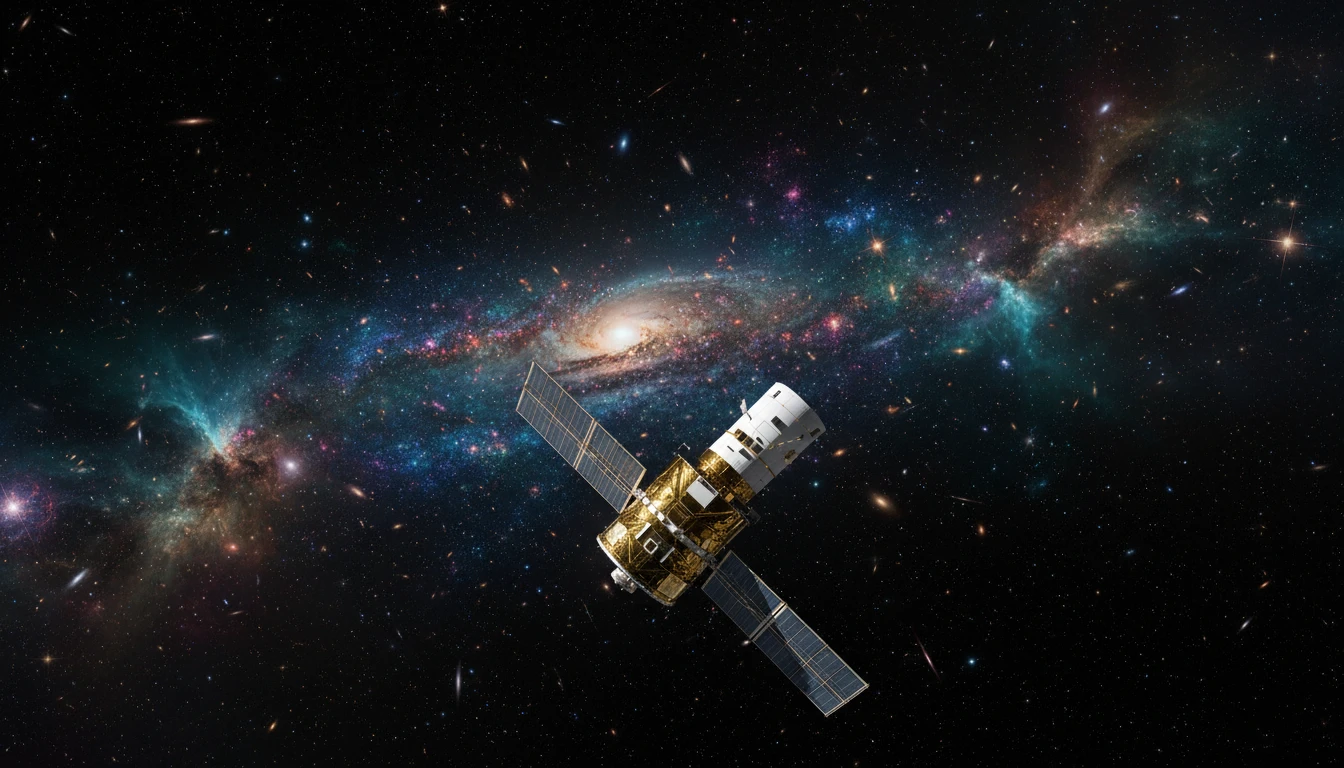
we are seeing it as it was 2.5 million years ago. The Hubble Space Telescope can see objects so far away that their light has taken over 13 billion years to reach us. This means Hubble is effectively a time machine, allowing astronomers to see what galaxies looked like in their infancy, not long after the Big Bang. This 'lookback time' is the fundamental principle that allows us to study the universe's history directly.
The Universe's Invisible Skeleton
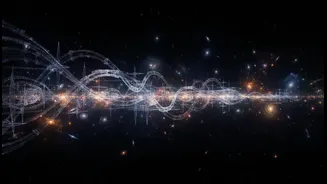
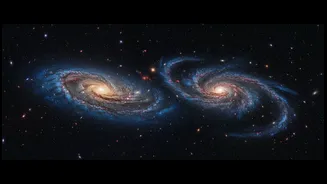
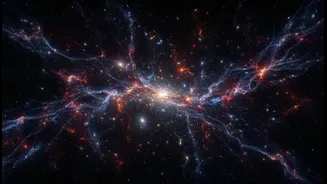
On the largest scales, the universe isn't a random scattering of galaxies. Instead, it's organised into a colossal, web-like structure. Imagine countless threads of a spider's web connecting in dense knots; this is what astronomers call the 'cosmic web'. The long, filamentary threads are made of gas and invisible dark matter, and where these filaments intersect, we find massive clusters of galaxies. Most of the ordinary matter in the universe isn't found in stars or galaxies, but in this tenuous, widespread gas between them, known as the intergalactic medium (IGM). This cosmic web is the fundamental framework of the universe, and understanding its structure is key to understanding how galaxies, including our own Milky Way, formed and evolved.
Cosmic Lighthouses to Map the Fog
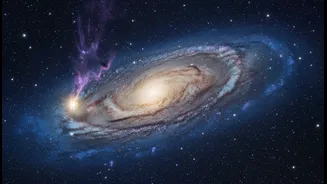
The challenge for astronomers is that this cosmic web is mostly invisible. The gas that makes it up is too thin and diffuse to be seen directly. So, how do they map it? They use the universe's brightest beacons: quasars. A quasar is an incredibly luminous galactic core, powered by a supermassive black hole. They are so bright they can be seen from across the observable universe, outshining their host galaxies. These quasars act like cosmic lighthouses, shining their powerful beams of light across billions of light-years. As this light travels toward Earth, it passes through the filaments of the cosmic web—the invisible 'fog' that scientists want to map.
How Hubble Reads the Light
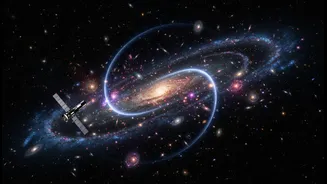
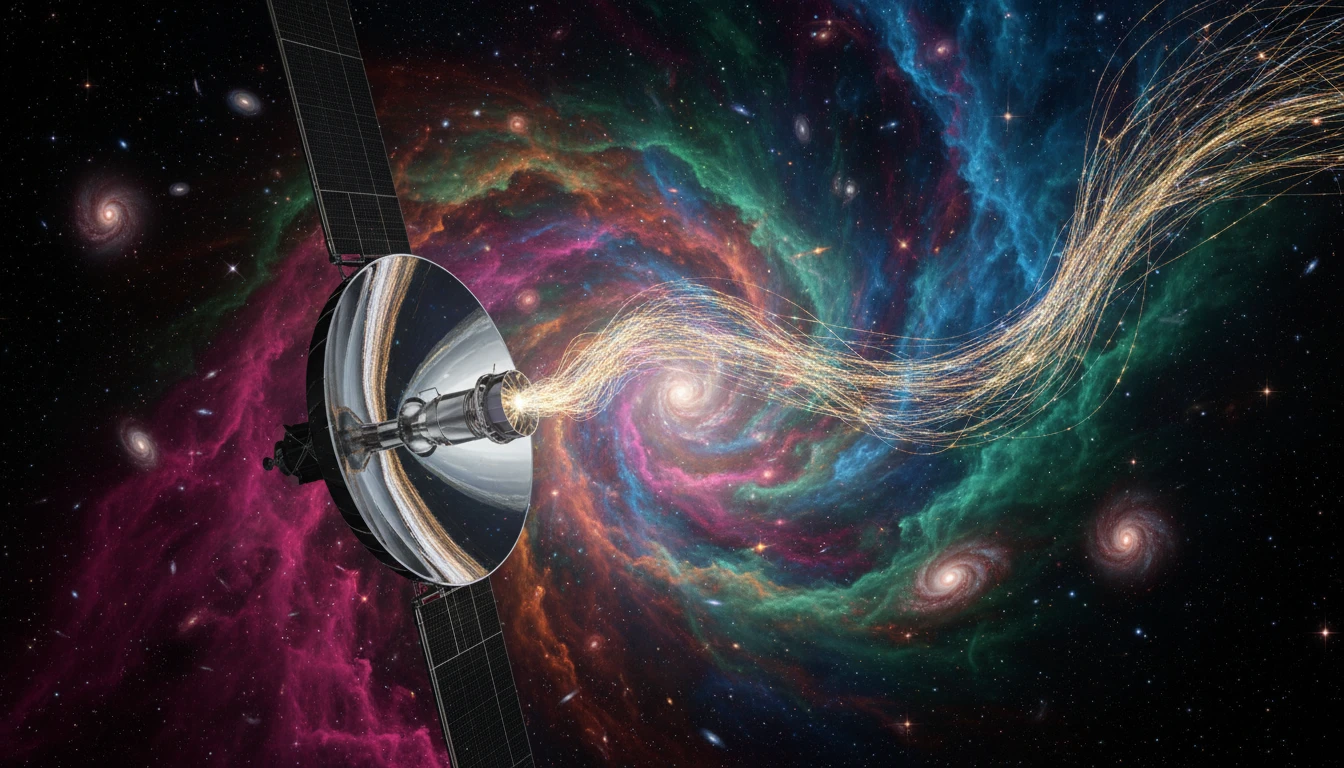
This is where the Hubble Space Telescope's genius comes in. It's not just about taking beautiful pictures. Hubble is equipped with highly sensitive instruments called spectrographs, like the Cosmic Origins Spectrograph (COS). A spectrograph works like a prism, splitting light into its constituent colours, or wavelengths. When light from a distant quasar passes through a cloud of intergalactic gas, the atoms in that gas—like hydrogen and oxygen—absorb very specific wavelengths of light. When Hubble’s spectrograph analyses the light, it sees a spectrum with dark, missing lines. These 'absorption lines' are the fingerprints of the gas cloud. They tell scientists what the cloud is made of, its temperature, its density, and how far away it is.
Building the 3D Map
By observing thousands of quasars located in different parts of the sky, astronomers can repeat this process over and over. Each line of sight to a quasar provides a core sample through the cosmic web, revealing the pockets of gas it passed through on its long journey. By combining all of these core samples, scientists can build a three-dimensional map of the cosmic web's structure across billions of light-years. Recent discoveries, such as Hubble's observation of a very early galaxy known as MXDFz4.4, even show us how the very first galaxies began to burn through the primordial fog of the early universe, making it transparent and shaping the cosmic web we see today.