


The Rise of 'Active Asteroids'
For decades, asteroids were considered geologically inactive chunks of rock, mostly orbiting in the main asteroid belt between Mars and Jupiter. Comets, on the other hand, are famous for their spectacular tails, which form when their ice turns to gas
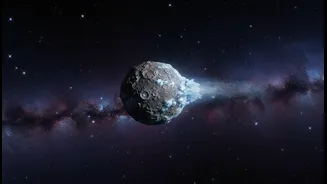
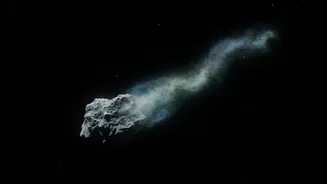
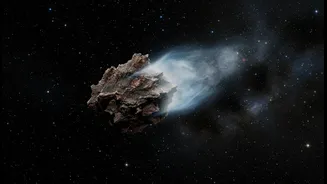
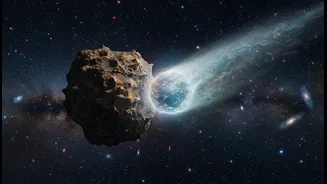
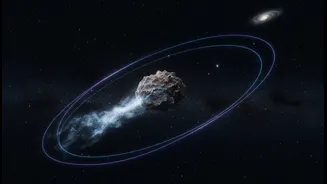
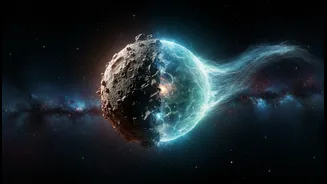
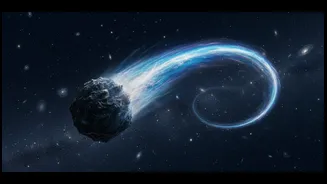
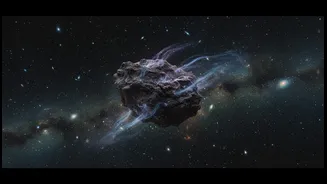
as they near the Sun. Recently, however, astronomers have identified a new class of object that blurs this distinction: the active asteroid. These bodies have the orbit of an asteroid but display comet-like visual characteristics, such as a tail or a cloud of dust and gas, known as a coma. This discovery has forced a major rethink, with citizen science projects like Active Asteroids helping to identify dozens of these rare objects, challenging what we thought we knew.
Evidence for Activity: The Case of 2005 QN173
A prime example is an object now designated 433P/(248370) 2005 QN173. Discovered in 2005, it was long considered a standard, inactive asteroid. But in July 2021, astronomers using the Asteroid Terrestrial-impact Last Alert System (ATLAS) noticed it had developed a long, narrow tail stretching over 720,000 kilometres. Further investigation of archival images showed it had also been active during a previous close approach to the Sun in 2016. This recurrent activity strongly supports the idea that the tail is caused by the sublimation of ice—the process of ice turning directly into gas—just like a comet. This makes it one of only a handful of objects confirmed to be a 'main-belt comet,' suggesting it is an icy asteroid that formed in the inner solar system.
Not So Fast: Alternative Explanations
However, a tail doesn't automatically mean an asteroid has turned into a comet. The evidence doesn't always point to sublimating ice. For instance, the surprising activity of asteroid Bennu, which was observed ejecting particles from its surface, is thought to be caused by different processes. One theory is thermal fracturing: the extreme temperature swings on the asteroid's surface as it rotates can cause rocks to crack and shed material. Another possibility for activity on any asteroid is a recent impact from a smaller object, which would kick up a cloud of dust and debris that could be mistaken for a tail. In some cases, an asteroid might be spinning so fast that it starts to fling material off its own surface.
The Strange Case of Phaethon's Sodium Tail
Then there is the strange case of 3200 Phaethon, the asteroid responsible for the annual Geminid meteor shower. For years, it was called a “rock comet” because it brightens and forms a tail near the Sun, yet seemed to have no ice. Scientists long assumed this tail was made of dust. But recent studies have upended that idea. Observations from NASA's solar observatories revealed that Phaethon's tail isn't dusty at all—it's made of sodium gas. Researchers believe that as Phaethon gets scorched by the Sun, the intense heat vaporises sodium trapped within its rock, which then fizzes into space. This unique mechanism shows there are more ways for a space rock to be active than we ever imagined.
Why These 'Zombie Rocks' Matter
These discoveries are more than just cosmic curiosities. They have profound implications for understanding our solar system's history. Active asteroids in the main belt, if they are indeed icy, could be a key source for explaining how Earth got its water. They represent a class of objects that could have delivered water to the inner planets billions of years ago. Understanding their behaviour is also crucial for planetary defence. While an asteroid's orbit is typically predictable, one that is actively ejecting material could experience slight changes in its trajectory. For potentially hazardous asteroids like Phaethon, knowing exactly what drives their activity is essential for accurately predicting their future path.