



The Allure and Anxiety of Asteroid Tracking
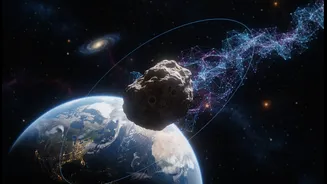
Our solar system is a busy place, filled with millions of rocky bodies left over from its formation. Most are harmlessly distant, but some, known as Near-Earth Objects (NEOs), have orbits that bring them close to our planet. For decades, tracking these
objects was the exclusive domain of professional astronomers. Today, thanks to the explosion of public data and citizen science, anyone with a computer can join the hunt. This has sparked a passion for astronomy in many, but it also comes with a significant challenge: the risk of creating false certainty from incomplete information.
Data Overload and the Certainty Problem
When a new asteroid is discovered, the initial observations provide only a rough sketch of its trajectory. With just a few data points, an asteroid's orbital path can seem to have a high probability of hitting Earth. This initial assessment, often based on a short observation arc, can be misleading. The problem is that early, uncertain data can be presented with the same gravity as well-established facts, leading to what is called "false certainty." Headlines can scream about a "doomsday asteroid" based on preliminary calculations that astronomers know are likely to change. As more observations are gathered over days and weeks, the orbit becomes much clearer, and the initial high-risk probability almost always drops to zero. This cycle of alarm followed by retraction can create public confusion and mistrust, a classic case of crying wolf in the cosmos.
Enter ESA’s NEO Toolkit
To address this, the European Space Agency’s (ESA) Near-Earth Object Coordination Centre (NEOCC) developed the NEO Toolkit. Launched in 2022 and expanded since, this suite of free, web-based tools is designed for everyone from professional astronomers to students, journalists, and the curious public. The toolkit includes several key components, such as the Orbit Visualisation Tool, the Flyby Visualisation Tool, and the Observation Planning Tool. Instead of just providing raw numbers, these tools offer a rich, visual, and contextual way to understand what the data actually means. They are specifically designed to provide accurate visuals and data for anyone with an interest in asteroids.
Designed for Discovery, Not Panic
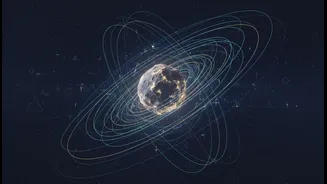
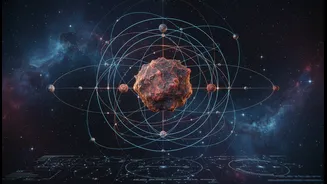
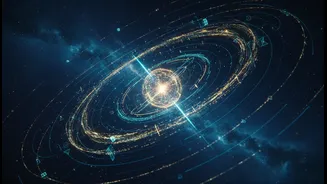
The toolkit's genius lies in how it handles uncertainty. Rather than presenting a single, potentially scary trajectory, the tools can illustrate the range of possible orbits. The Orbit Visualisation Tool, for instance, allows users to see the perturbed orbits of NEOs in a 3D model of the solar system. This makes it intuitively clear why more observations are needed to narrow down an object's future path. For example, a user can visualize how an asteroid's classification can change after a close flyby with a planet, as will happen with the asteroid Apophis in 2029. The system also distinguishes between different data qualities, helping users understand why some objects are on an urgent watch list while over 95% of known NEOs pose no threat in the coming century. This approach teaches a crucial lesson in scientific literacy: data evolves, and certainty is earned through rigorous observation, not assumed from a single data point.
A Classroom Window to the Cosmos
For students and educators in India and around the world, these tools are a powerful educational resource. They transform abstract concepts like orbital mechanics into an interactive experience. A teacher can use the Sky Chart Display Tool to show students exactly where to look for an asteroid from their specific location on Earth. Using the Flyby Visualisation Tool, a class can simulate a high-precision close approach, understanding the immense scale and dynamics involved. This is inquiry-based learning at its best, allowing students to work with the same data and tools as professionals. It fosters critical thinking and data literacy by moving beyond simple facts and engaging with the scientific process itself—uncertainties and all. By providing access without promoting false certainty, ESA's tools help cultivate a more informed and scientifically-minded generation.