





The Real Power of Five Minutes
Let’s be clear: a five-minute workout won't give you superhero strength overnight. Its true magic lies in consistency. Research shows that it can take over two months to form a new habit, and the key is making the task so easy it's hard to skip. A short,
daily routine removes common excuses like 'I don't have time'. By committing to just five minutes, you are building the mental foundation for a more active lifestyle. Studies suggest these short bursts of activity, sometimes called 'exercise snacks', can significantly improve physical fitness and even mental health for sedentary individuals. The goal is progress, not perfection. Consistency is more important than intensity when you're just starting out.
Minute 1: The Dynamic Warm-Up
Never jump into a workout cold. A proper warm-up prepares your muscles and joints for movement, reducing the risk of injury. Spend the first minute getting your blood flowing. Start by marching in place, lifting your knees towards your chest. After about 30 seconds, transition to arm circles—ten forward and ten backward—to loosen up your shoulders. You can also incorporate gentle torso twists or leg swings. The goal is to feel a little warmer and more mobile, signaling to your body that it's time to work.
Minute 2: Lower Body with Bodyweight Squats
Squats are a fundamental exercise that strengthens your legs and glutes, muscles you use every day for things like standing up from a chair. To perform a proper bodyweight squat, stand with your feet shoulder-width apart and your toes pointing slightly outward. Keep your chest up and your back straight as you hinge at your hips and bend your knees, lowering your body as if you're about to sit in a chair. Go as low as you comfortably can while keeping your heels on the floor. Then, push through your feet to return to the starting position. Focus on controlled movement, inhaling as you go down and exhaling as you push up.
Minute 3: Upper Body with Wall Push-Ups
Push-ups are excellent for building upper body and core strength, but the standard version can be challenging for beginners. Wall push-ups are a fantastic starting point. Stand facing a wall, about an arm's length away. Place your palms on the wall, slightly wider than your shoulders. Keeping your body in a straight line from your head to your heels, bend your elbows and lean your chest toward the wall. Pause, then push back to the starting position. This modification allows you to build strength safely before progressing to more difficult variations.
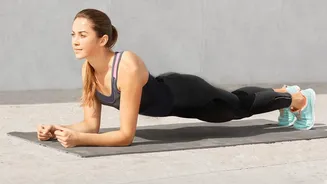
Minute 4: Core Stability with a Plank
A strong core is essential for posture and overall stability. The plank is a simple but effective exercise to engage these muscles. You can start on your knees or in a full plank position. Place your forearms on the floor with your elbows directly under your shoulders. Engage your core muscles to keep your body in a straight line, being careful not to let your hips sag or rise too high. Hold this position for as long as you can maintain good form, even if it's just 15-20 seconds to start. As you get stronger, you can gradually increase the holding time.
Minute 5: Cardio Burst with Jumping Jacks
Finish your five-minute routine with a minute of cardiovascular exercise to elevate your heart rate. Jumping jacks are a classic choice because they are a full-body movement that requires no special coordination. Stand with your feet together and arms at your sides. In one motion, jump your feet out to the sides while raising your arms overhead. Jump back to the starting position and repeat. If jumping is too high-impact, you can do walking jacks by stepping one foot out at a time instead.