




Cosmic Lighthouses and Their Winds
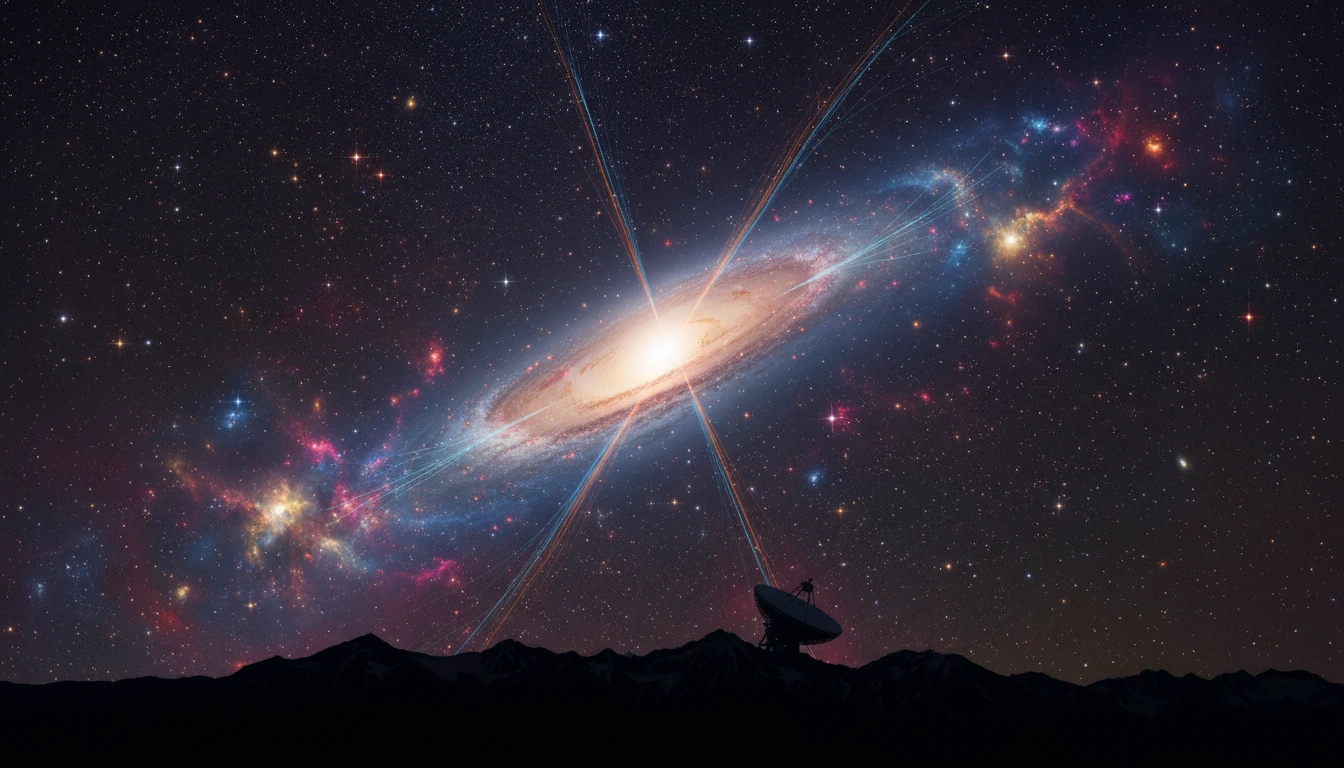
When a massive star dies in a supernova, it can leave behind a city-sized, ultra-dense core called a neutron star. Some of these neutron stars spin incredibly fast and have powerful magnetic fields, causing them to emit beams of radiation that sweep across
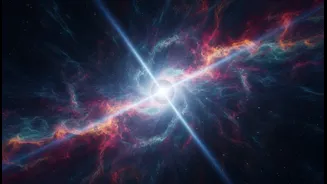
the cosmos like a lighthouse beam. We call these objects pulsars. This isn't a gentle glow; the pulsar unleashes a ferocious, non-stop gale of particles and energy called a pulsar wind. This wind, moving at nearly the speed of light, slams into the surrounding gas and dust from the original supernova, creating a vast, glowing structure known as a pulsar wind nebula. Think of it as the beautiful, chaotic aftermath of a cosmic storm, powered entirely by the spinning pulsar at its heart.
The Particle Acceleration Puzzle
For decades, astronomers have been puzzled by these nebulae. While they understood that the pulsar’s wind powers the nebula’s glow, they couldn't fully explain how the particles within that wind get accelerated to such incredible energies, especially far away from the pulsar itself. The wind is fiercest near the pulsar, but the particles seem to get a second, massive energy boost at a boundary called the termination shock, where the wind abruptly slows down. Existing models struggled to account for the sheer power and structure observed. Scientists knew the nebula's magnetic field was the key, but they couldn’t map it effectively. It was like trying to understand a storm's structure by only seeing the lightning flashes, without being able to see the wind itself.
A New Pair of Sunglasses for X-Rays
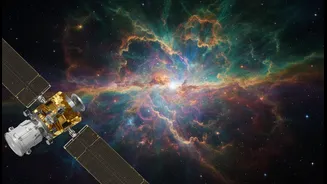
This is where NASA's Imaging X-ray Polarimetry Explorer (IXPE) changes the game. Launched in late 2021, IXPE is a space observatory designed to do something unique: measure the polarization of X-rays from cosmic objects. Polarization is a property of light that tells us how its waves are oriented. For astronomers, measuring the polarization of X-rays coming from a nebula is like putting on a pair of polarized sunglasses. It filters out the glare and reveals the underlying structure and direction of the magnetic field, which is otherwise invisible. By mapping the polarization across a nebula, IXPE essentially creates the first-ever detailed map of the magnetic field lines that shape it.
Mapping the 'Lighthouse Nebula'
Recent observations of the 'Lighthouse Nebula' and its pulsar, PSR J1101−6101, showcase IXPE's power. For nearly 18 days, the telescope stared at this faint structure, mapping its magnetic field for the first time. The results, published in mid-2026, confirmed a long-held theory: particles escaping the pulsar flow along the galaxy's own magnetic field lines. But the map also held a surprise. The degree of polarization was extremely high, indicating the magnetic field was far more orderly and less turbulent than many models had predicted. This suggests the process of accelerating particles is surprisingly efficient and tidy. Observations of other famous nebulae, like Vela and the Crab, have revealed similarly high levels of polarization, showing that these regions are highly structured.
Why This New Map Matters
This newfound ability to map magnetic fields is a breakthrough. It allows scientists to directly test their theories of particle acceleration in some of the most extreme environments in the universe. The high level of order seen in the Lighthouse and Vela nebulae supports a mechanism where the magnetic field itself realigns and snaps, a process called magnetic reconnection, which transfers enormous energy to the particles. Understanding this process in pulsar wind nebulae doesn't just solve a niche astronomical puzzle. It provides a real-world laboratory for studying fundamental plasma physics that is relevant to other cosmic phenomena, from the jets fired by supermassive black holes to the behavior of our own sun. These 'lighthouse maps' are giving us a new understanding of how the universe's most powerful particle accelerators work.