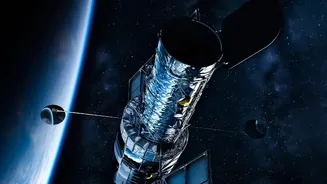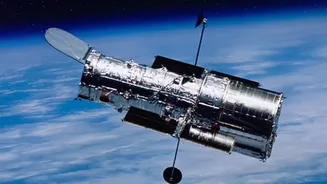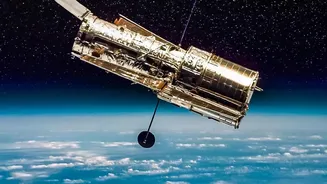





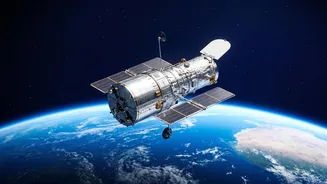

For over 35 years, the Hubble Space Telescope has been humanity’s eye on the cosmos. But its legendary journey is threatened by a slow, relentless fall toward Earth. Now, NASA is turning to the private sector for a novel rescue mission.
The Inevitable Descent
Like all satellites
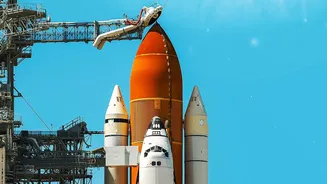
in low Earth orbit, Hubble is subject to atmospheric drag. Even at its altitude, hundreds of kilometers above the surface, there are traces of atmosphere that create a tiny but constant braking force. Over three decades, this drag has caused Hubble's orbit to decay, and it is gradually losing altitude. The telescope has no onboard propulsion system to correct its path; it was designed to be serviced by Space Shuttles, which could push it back to a higher orbit. With the shuttle fleet retired since 2011, Hubble has been on a slow, uncorrected descent. Without intervention, NASA predicts the telescope will re-enter the atmosphere and be destroyed sometime in the mid-2030s.
A Call for Commercial Solutions
Recognizing the risk, NASA has formally issued a Request for Information (RFI), asking the commercial space industry for ideas on how to save its iconic observatory. This isn't a firm contract but rather a market research effort to see what's possible. The RFI outlines three main possibilities: boosting Hubble to a higher, more stable orbit; servicing the telescope to enhance its performance; or, as a last resort, guiding it to a safe, controlled reentry over the ocean. The primary goal is to push Hubble to an altitude of at least 600 kilometers, which could add another 15 to 25 years to its operational life. Any potential mission would need to launch by 2032 to be effective.
The Dawn of In-Orbit Servicing
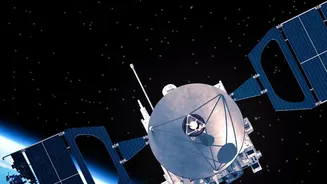
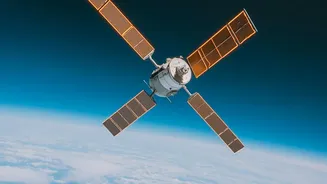
This request signals a major shift in space operations. The missions that once required the full might of a government space agency and its astronaut corps might now be accomplished by private companies. This public-private partnership model has already proven successful for resupplying the International Space Station and launching astronauts. Extending this model to servicing a high-value asset like Hubble, which was never designed to be handled by robots, is a new frontier. A successful mission would not only save a priceless scientific instrument but would also serve as a powerful proof-of-concept for an entire commercial market focused on the in-orbit servicing, repair, and life extension of satellites.
Potential Rescuers and Technical Hurdles
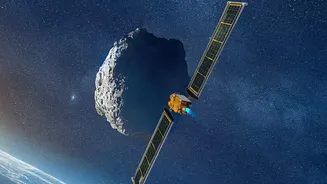
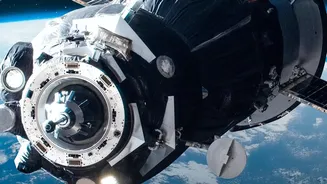
The technical challenge is immense. A commercial spacecraft must launch, autonomously rendezvous with Hubble, and then securely dock with or grapple the telescope without damaging its delicate, aging instruments. In 2022, NASA and SpaceX signed an unfunded agreement to study the feasibility of using a Dragon spacecraft for this very purpose, a study done in partnership with the private Polaris Program led by billionaire Jared Isaacman. While that initial study concluded a mission was technically possible, NASA's new, broader request for information opens the door to other innovative solutions from a rapidly evolving industry. The mission would be entirely robotic, a stark contrast to the five crewed shuttle missions that previously serviced the telescope.
Why Saving Hubble Still Matters
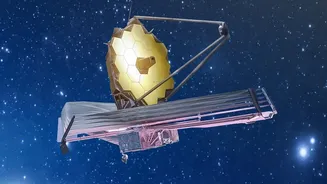
While the James Webb Space Telescope has captured the world's imagination with its stunning infrared images, it is not a replacement for Hubble. Hubble remains a powerhouse for observing the universe in visible and ultraviolet light, providing a unique and essential perspective that Webb cannot. Extending its life would preserve these critical capabilities, allowing for continued discoveries in planetary science and cosmology. As NASA officials have stated, there is a responsibility to both taxpayers and the scientific community to explore every cost-effective way to keep this legendary observatory delivering groundbreaking science for as long as possible.