




A New Era for the Moon
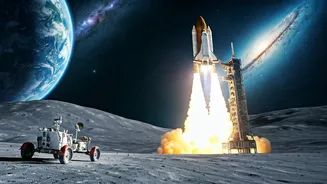
While the historic return of astronauts to the lunar surface on Artemis III has been rescheduled to 2027, its predecessor, Artemis II, successfully sent a crew on a flyby of the Moon in April 2026, marking humanity's first venture beyond low-Earth orbit
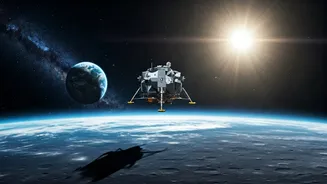
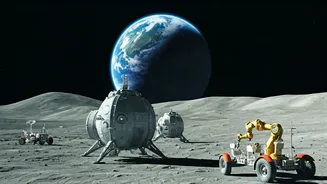
since 1972. [2, 5, 11] The momentum continues in 2026 with a focus on robotic and international missions that are laying the critical groundwork. China's ambitious Chang'e 7 mission is slated to launch for the lunar south pole in August 2026. [1, 6] This robotic lander, rover, and mini-flying probe aim to explore the resource-rich Shackleton Crater, searching for the water ice that could be vital for future long-term human outposts. [1] Simultaneously, multiple American commercial companies, under NASA's Commercial Lunar Payload Services (CLPS) program, are sending their own landers. [5] Missions from Intuitive Machines (IM-3) and Firefly Aerospace (Blue Ghost Mission 2) are planned, with the latter aiming for a landing on the far side of the Moon. [5] Astrobotic's Griffin Mission One will also carry NASA's VIPER rover to the south pole, demonstrating a growing private-sector capability that is fundamental to the new space economy.
The Rise of the Commercial Giants
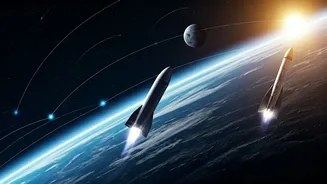
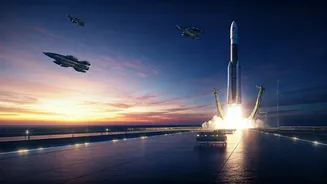
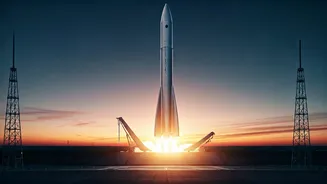
The year 2026 signifies a major acceleration for commercial spaceflight, led by SpaceX and its revolutionary Starship. With an ambitious launch cadence, SpaceX is pushing the development of the world's most powerful rocket, essential for both NASA's Artemis plans and the company's own Mars ambitions. [9, 11, 15] Starship development is expected to see major compounding progress in 2026, with a focus on demonstrating in-orbit refueling for the first time—a key technology for deep-space missions. [11] Beyond SpaceX, Blue Origin plans to launch a demonstration mission of its Blue Moon lander in early 2026. [6, 11] The year also marks a critical phase for the future of commercial space stations. [12] With the International Space Station's retirement planned for around 2030, NASA is funding a new generation of private habitats. [12, 18, 23] In 2026, Axiom Space plans to attach its first commercial module to the ISS, a major step toward creating a free-flying private station later on. [12] These ventures signal a major shift from government-led exploration to a vibrant LEO economy.
A Truly Global Push Outward
The new era in space is increasingly multipolar. China's space program will be exceptionally active in 2026, with two planned crewed missions to its Tiangong space station and continued development of its hardware for a crewed lunar landing before 2030. [3, 4, 7, 10] These missions will include international partners, with a Pakistani astronaut scheduled to visit Tiangong. [3, 7] In another landmark mission, the Japan Aerospace Exploration Agency (JAXA) will launch its Martian Moons Exploration (MMX) probe in November 2026. [1] The ambitious mission aims to land on Mars's moon Phobos and return a sample to Earth, potentially solving the mystery of how the Martian moons were formed. [1] Meanwhile, India's space agency, ISRO, is targeting an uncrewed test flight of its Gaganyaan spacecraft, a critical step toward its goal of sending Indian astronauts into orbit. [5, 16] This global flurry of activity demonstrates a shared, if competitive, drive to push the boundaries of exploration.
Robots Charting the Unknown
While human missions capture headlines, 2026 will also be a banner year for robotic explorers. In November, the joint ESA-JAXA BepiColombo mission is scheduled to finally enter orbit around Mercury after an eight-year journey, promising to double the number of spacecraft that have ever studied the innermost planet up close. [1] Also in November, the European Space Agency's Hera mission will arrive at the Didymos-Dimorphos asteroid system. [1] Hera will act as a cosmic detective, surveying the aftermath of NASA's 2022 DART mission, which successfully altered an asteroid's orbit. [1] By studying the impact crater and the asteroid's composition, scientists will gather crucial data for developing planetary defense strategies. [1] These robotic missions are not just scientific curiosities; they are essential pathfinders, gathering the data and testing the technologies needed to ensure future human missions are safe and successful.