




A Landmark Discovery in a Distant World
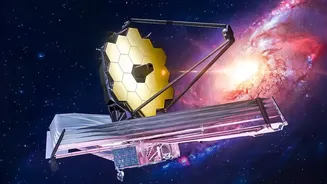
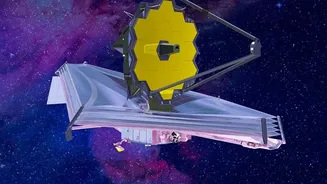
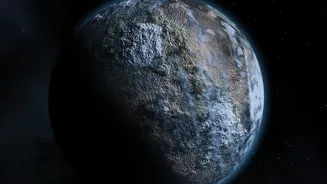
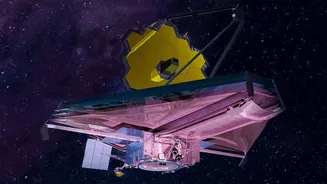
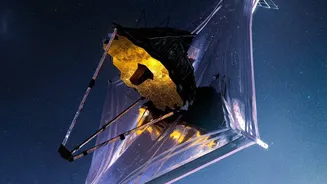
The James Webb Space Telescope has added another remarkable achievement to its growing list: identifying traces of water vapour in the atmosphere of an exoplanet. The subject of this groundbreaking observation is WASP-18 b, an 'ultra-hot' gas giant located
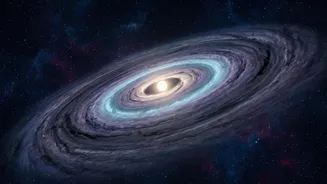
about 400 light-years from Earth. This world is unlike anything in our solar system; it is ten times more massive than Jupiter and orbits its star in a mere 23 hours. The detection of water, even in small amounts, in such an extreme environment showcases the incredible sensitivity of the JWST and opens a new chapter in our exploration of worlds beyond our own.
How Webb 'Sees' an Alien Atmosphere
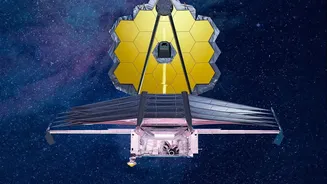
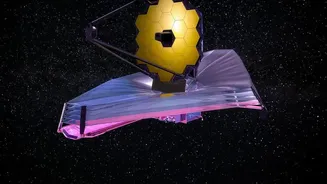
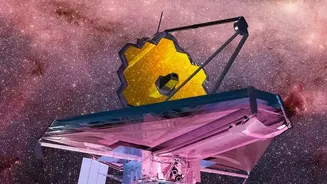
Detecting elements from hundreds of light-years away sounds like science fiction, but it is the core of the JWST's mission. The technique used is a form of spectroscopy. As an exoplanet passes in front of its host star from our perspective, the star's light filters through the planet's atmosphere. Different molecules in the atmosphere absorb specific colours, or wavelengths, of light. This creates a unique chemical 'fingerprint'. By analysing the starlight that reaches its advanced instruments, the JWST can identify the molecules present, including the tell-tale signature of water vapour. This observation of WASP-18 b is one of the most detailed of its kind, marking a significant advancement from previous analyses by telescopes like Hubble.
An Extreme and Fascinating Planet
WASP-18 b is a world of extremes. It is tidally locked, meaning one side permanently faces its star, much like the Moon does with Earth. This 'dayside' experiences scorching temperatures reaching nearly 2,700 degrees Celsius, hot enough to break water molecules apart. The fact that Webb detected water vapour at all under these conditions is a testament to its power. Using its instruments, scientists were also able to create a temperature map of the planet. This revealed a massive temperature drop—up to 1,000 degrees—from the hottest point facing the star to the 'terminator' line where day meets night. Such data helps scientists understand the complex dynamics of exoplanet atmospheres and why heat isn't being distributed efficiently to the night side.
Why Finding Water Vapour Matters
Water is a cornerstone for life as we know it, acting as a universal solvent and facilitating critical biological processes. While the discovery of water vapour on a scorching gas giant like WASP-18 b does not imply the planet is habitable, it is a crucial proof of concept. It demonstrates that our technology can detect this vital molecule across vast cosmic distances. Each detection helps astronomers refine their models of how planets form and where water might be found. This capability is a stepping stone toward analysing the atmospheres of smaller, rocky, and potentially habitable planets, bringing us closer to answering the ultimate question: are we alone in the universe?
The Next Frontier for Exoplanet Science
This discovery is just the beginning. The JWST's mission is ushering in what many scientists call a 'new era in exoplanet research'. Astronomers are now using the telescope to study a wide variety of worlds, from gas giants to rocky planets in the habitable zones of their stars, like those in the famous TRAPPIST-1 system. Each observation provides a wealth of data, allowing scientists to measure the abundance of different elements, estimate atmospheric temperatures, and piece together the formation history of these planets. While challenges remain, such as distinguishing a planet's atmospheric signal from its star's, the JWST is equipped to push through these barriers, promising many more thrilling discoveries in the years to come.