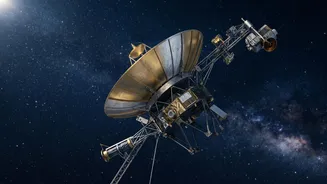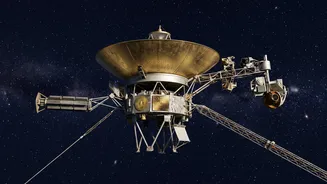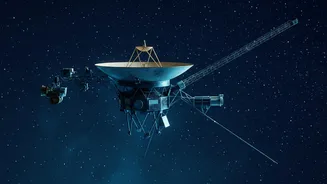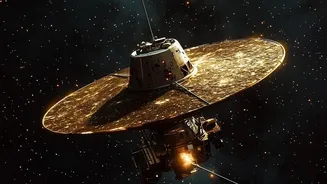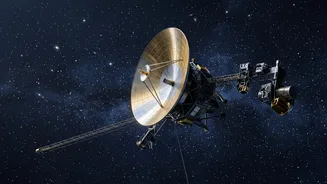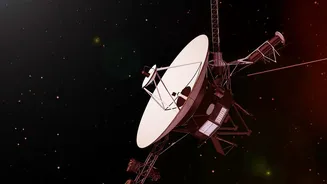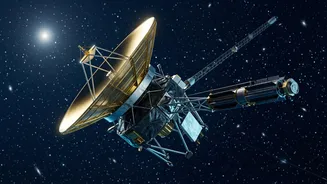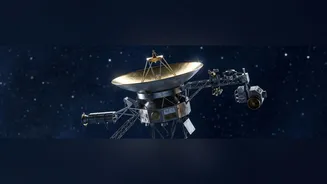




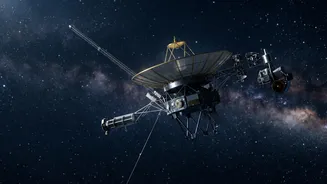

Humanity’s farthest envoy, the Voyager 1 spacecraft, recently gave its creators a scare. After nearly 50 years of exploring the cosmos, the probe briefly went silent, prompting a delicate and patient investigation from billions of kilometres away.
A Faint Whisper Goes Silent
In mid-October
2026, NASA's Deep Space Network (DSN), a global array of massive radio antennas, strained to hear Voyager 1's faint signal during two scheduled check-ins, but was met with silence. For 48 anxious hours, the line to our most distant robotic explorer was dead. The probe, now traveling through interstellar space more than 25 billion kilometres from Earth, had missed its calls home. Then, as mysteriously as it vanished, the signal reappeared on October 20. While communication has been stable since, a team of dedicated engineers at NASA's Jet Propulsion Laboratory (JPL) is now working to piece together what caused the two-day gap.
Diagnosing from a Light-Day Away
Troubleshooting a computer glitch is hard enough, but imagine doing it when the device is so far away that your message takes a full day to arrive. That's the challenge facing the Voyager team. On November 18, 2026, the spacecraft will reach the incredible milestone of being one light-day from Earth. This means a radio command, travelling at the speed of light, requires 24 hours just to reach the probe. Any response or diagnostic data sent back takes another 24 hours to return. This 48-hour round-trip time makes every step of the investigation a painstaking exercise in patience, requiring engineers to send a command and then wait two full days for the result.
Clues from an Aging Explorer
While the root cause of the signal loss is still under investigation, initial findings point to the spacecraft's own self-preservation instincts. Engineers have determined that one of Voyager 1's thruster groups went offline, which automatically triggered its backup system to turn on. This swap is a pre-programmed safety measure, designed to put the spacecraft into a stable state if its computers detect a problem. Such anomalies are becoming more expected as the probe ages. Launched in 1977, Voyager 1 operates on technology from a bygone era, and its plutonium power source slowly diminishes by about four watts each year. These challenges force engineers to be increasingly creative, recently performing a power-saving maneuver nicknamed the 'Big Bang' to keep its remaining science instruments running longer.
Why This 49-Year Old Mission Still Matters
Long after completing its primary mission of touring Jupiter and Saturn, Voyager 1 continues to make history. It is the first and only humanmade object to enter interstellar space—the region between star systems. It carries the famous 'Golden Record', a gold plated copper disk containing sounds and images selected to portray the diversity of life and culture on Earth, a message in a bottle cast into the cosmic ocean. The probe's ongoing journey provides invaluable data about the environment outside our solar bubble, measuring particles and magnetic fields no other craft has ever reached. Its longevity is a testament to the engineers who built it and the teams who have guided it for nearly half a century.
The Patient Path Forward
The Voyager team is methodical. Having successfully restored communications after a more serious five month issue earlier in 2024, they have proven their ability to solve problems across unimaginable distances. 'We are also at a point in the mission where we have to expect the unexpected,' said Kareem Badaruddin, Voyager's mission manager at JPL. The current investigation will continue one slow, deliberate step at a time. The goal is not just to understand the recent anomaly but to ensure that Voyager 1 can continue its lonely trek for as long as possible. Each day it operates, it pushes the frontier of human exploration a little bit farther into the vast, unknown territory of interstellar space.