



The Problem With Today's Batteries
Almost every electric scooter on Indian roads today runs on a lithium-ion battery. This technology, while functional, has significant limitations. The primary hurdle is cost. The materials and complex manufacturing process make the battery the single
most expensive component of an EV, directly inflating the showroom price. Beyond cost, these batteries use a flammable liquid electrolyte, which poses a fire risk if damaged or improperly managed. This necessitates complex and heavy cooling and safety systems, adding more weight and expense. Finally, charging times can be long, and performance often dips in very hot or cold weather, a common issue for riders across India.
Enter the Solid-State Solution
Solid-state batteries are the next frontier in energy storage. The core innovation is replacing the liquid electrolyte with a solid material, often a ceramic or polymer. This simple change has a cascade of benefits. A solid electrolyte is not flammable, which drastically reduces the risk of fires and eliminates the need for bulky liquid containment and cooling systems. This makes the battery packs inherently safer and lighter. The stability of the solid material also allows for the use of more energy-dense materials, like a lithium metal anode, which can store significantly more power in the same amount of space.
More Range, Faster Charging, Better Safety
For an EV scooter rider, the advantages are transformative. Higher energy density means a scooter could potentially double its range without needing a larger or heavier battery pack. Imagine a typical 100-kilometre range scooter being able to travel 180 or 200 kilometres on a single charge. The stability of the solid electrolyte also allows it to handle higher charging currents, slashing charging times from several hours to potentially under 30 minutes. Furthermore, the elimination of flammable liquids provides genuine peace of mind, especially for users who store and charge their scooters inside their homes. These batteries are also more durable and less prone to degradation over time, offering a longer lifespan.
Recent Breakthroughs Signal a Shift
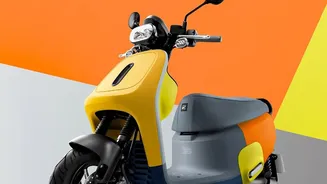
What was once a laboratory concept is now entering the early stages of commercial reality. As of September 2026, the industry is seeing significant movement. The Taiwanese firm ProLogium Technology recently announced the start of mass production for its high-energy-density solid-state batteries at its giga-scale facility. Their cells have passed independent tests, qualifying as true all-solid-state batteries. While these initial production runs are aimed at the automotive market, the manufacturing knowledge and scaling are directly applicable to smaller formats for two-wheelers. Meanwhile, companies like Gogoro have already demonstrated prototype solid-state battery packs for their swappable scooter systems, and other firms are road-testing the technology in development vehicles.
How This Leads to Cheaper Scooters
While new technology is often expensive at first, solid-state batteries have a clear path to becoming cheaper than current lithium-ion options. First, they can be made with more abundant and less expensive materials, reducing reliance on costly and geopolitically sensitive metals like cobalt. Second, their simpler design—with no need for extensive cooling systems, pumps, and liquid containment—reduces the bill of materials and simplifies manufacturing. As companies like ProLogium ramp up mass production, economies of scale will kick in, driving down the unit cost dramatically. This cost saving can be passed directly to the consumer, making entry-level EV scooters more affordable than ever.