



An Eruption from the Sun
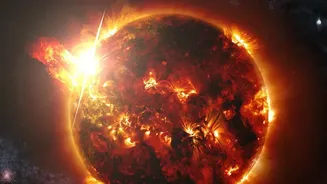
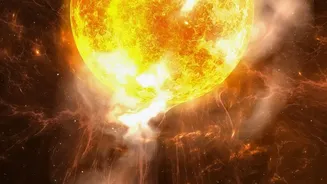
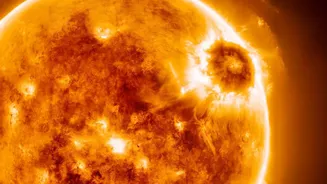
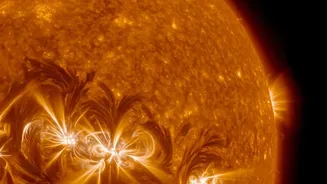
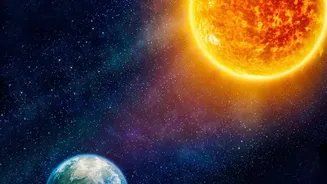
A Coronal Mass Ejection, or CME, is a massive explosion in the Sun's outer atmosphere, the corona. These events launch billions of tonnes of plasma and embedded magnetic fields into space. Think of it as a colossal cannonball of superheated gas and magnetic energy.
These ejections can happen multiple times a day during the Sun's active periods and travel at speeds ranging from a relatively leisurely 250 km/s to an astonishing 3,000 km/s. This means the fastest CMEs can journey the 150 million kilometres to Earth in less than a day.
From Solar Blast to Geomagnetic Storm
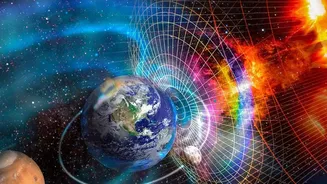
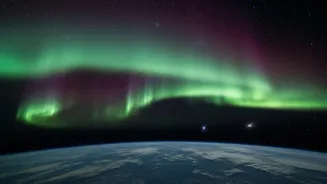
When a CME is aimed at Earth, it travels through space as an interplanetary storm cloud. If this cloud collides with our planet's magnetosphere—the natural magnetic shield surrounding Earth—it causes a major disturbance known as a geomagnetic storm. This interaction is an efficient exchange of energy from the solar wind into our space environment. The CME compresses our magnetic field and can cause it to reconfigure, allowing energetic particles to funnel down towards the poles, creating spectacular auroras but also posing significant risks.
The Risk to Our Wired World
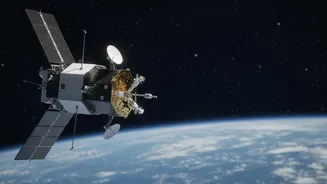
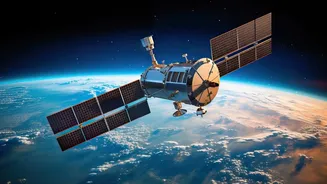
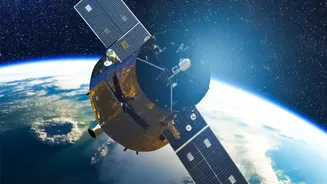
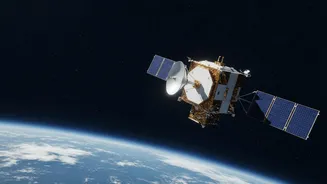
While beautiful, intense geomagnetic storms are a serious threat to our technology-dependent society. They can induce powerful, uncontrolled currents in power lines, known as geomagnetically induced currents (GICs). These GICs can overload and damage high-voltage transformers, potentially leading to widespread and long-lasting blackouts, as famously occurred in Quebec in 1989. Satellites are also highly vulnerable; the charged particles can damage their electronics, and changes in atmospheric drag can alter their orbits, risking collisions. Communications and GPS systems can also be disrupted.
Beyond Speed: The Density Factor
For years, forecasting the impact of a CME largely focused on its speed and the orientation of its magnetic field. A southward-pointing magnetic field in a CME, for instance, interacts more strongly with Earth's northward-pointing field, intensifying the storm. However, recent advancements in modeling are adding a crucial third variable: particle density. Models like NASA's ENLIL simulate the solar wind and can show how density, mass, and magnetic fields evolve as a CME travels. This is a critical upgrade to our predictive capabilities.
Why Density Changes the Game
Measuring density provides a much clearer picture of the force a CME will carry. Think of the difference between a fast, light breeze and a slower but immensely heavy tsunami wave. While speed is important, the density of the particle cloud determines the momentum and energy that will be transferred to Earth's magnetosphere. A particularly dense cloud, even if not the fastest, can create a more powerful shock front and drive a more severe geomagnetic storm. By incorporating density, models can more accurately gauge the severity of the impending impact, moving beyond a simple arrival time forecast.
A Better Warning System
The goal of this improved modeling is to provide more accurate and reliable warnings. Better forecasting gives power grid operators crucial time to implement contingency plans to protect transformers and stabilise the system. Satellite operators can put their spacecraft into a protective safe mode, and airlines can reroute flights to avoid communication blackouts and radiation exposure on polar routes. As our world becomes ever more reliant on interconnected technologies, the ability to accurately predict the density, and therefore the punch, of an incoming solar storm is essential for mitigating damage and ensuring stability.