


What Exactly Is a Solar Storm?
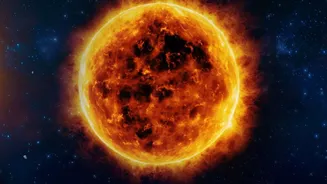
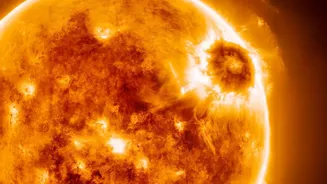
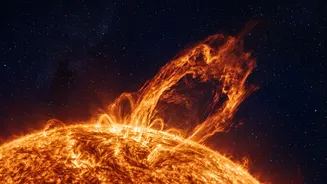
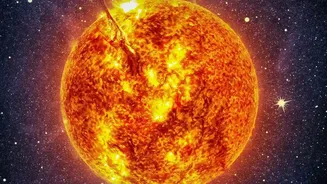
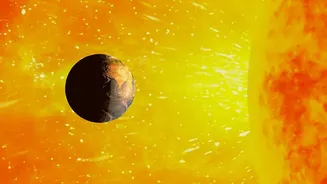
A solar storm is a powerful and explosive disturbance on the Sun. These events happen when immense energy stored in the Sun's twisted magnetic fields is suddenly released. This can manifest in two main ways: solar flares and coronal mass ejections (CMEs).
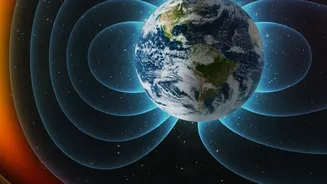
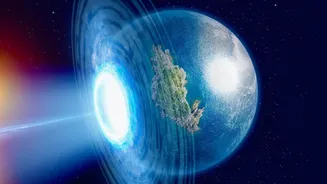
A solar flare is an intense burst of radiation—a flash of light and energy that can reach Earth in just minutes. A CME, on the other hand, is a colossal cloud of magnetised plasma and particles hurled into space, which can take anywhere from 15 hours to several days to reach our planet. When these storms are aimed at Earth, they can interact with our planet's protective magnetic field, creating what's known as a geomagnetic storm. This is the phenomenon responsible for both the beautiful auroras and the technological chaos that can follow.
Why Your GPS Might Get It Wrong
Global Positioning System (GPS) technology feels like magic, but it relies on a very precise process: satellites send signals to a receiver on the ground, and the time it takes for those signals to travel is used to calculate your exact location. For this to work, the signal must pass through Earth's upper atmosphere, specifically a layer called the ionosphere. During a solar storm, incoming energy and particles supercharge the ionosphere, causing rapid fluctuations and irregularities. This atmospheric disturbance can delay, bend, or scramble the GPS signals passing through it. The result for users on the ground can range from positioning errors of a few metres to a complete loss of signal. For a driver in a city, this might be a minor inconvenience, but for precision agriculture, shipping, and aviation, even small errors can have serious consequences.
The Triple Threat to Aviation
The aviation industry is particularly vulnerable to the effects of space weather. First, there's the issue of communication. High-frequency (HF) radio, a crucial tool for pilots flying over oceans and polar regions where other options are limited, can be completely blacked out during a solar event. Second, navigation is compromised. When the ionosphere is disturbed, the accuracy of GPS and other satellite navigation systems degrades, forcing aircraft to fall back on older systems. Finally, there's the risk of increased radiation. Solar storms eject high-energy particles that, while blocked by our atmosphere at ground level, can reach the altitudes at which commercial jets fly, posing a potential health risk to crew and passengers on certain routes, especially those over the poles.
Our Fragile Communications Web
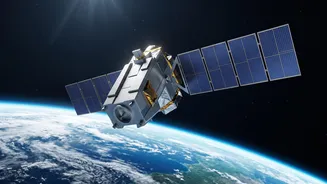
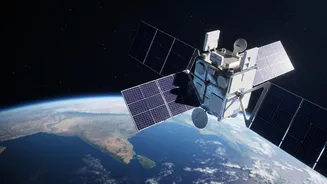
Much of our modern world runs on satellites orbiting Earth. They relay everything from television broadcasts and financial transactions to internet data and, of course, phone calls. Solar storms can harm these vital pieces of infrastructure in several ways. The high-energy particles can damage sensitive electronic circuits. The storm can also heat and expand Earth's upper atmosphere, increasing the drag on low-orbiting satellites, causing them to lose altitude and potentially fall out of orbit if not corrected. Even ground-based communication isn't entirely safe. Geomagnetic storms can induce currents in long conductors on the Earth's surface, which have historically caused damage to power grids and telegraph lines, and still pose a risk to modern infrastructure.
Watching the Sun to Protect the Earth
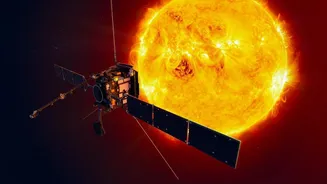
Given the risks, predicting space weather has become a global priority. Space agencies like NASA and NOAA in the US, and ISRO in India, constantly monitor the Sun for signs of activity. India's Aditya-L1 mission, for example, is dedicated to studying the Sun to better understand and forecast solar storms. This mission, along with other national initiatives in meteorology and atmospheric science, aims to create advanced warning systems. By providing alerts about incoming solar events, scientists give satellite operators, airlines, and power grid managers crucial time to take protective measures, such as rerouting flights, putting satellites into a safe mode, or isolating parts of the grid to prevent widespread blackouts.