








A Fleeting Glimpse in the Dark
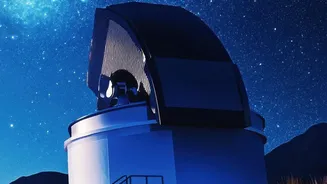
Finding a new asteroid is a monumental task, often accomplished by automated telescopes that relentlessly scan the night sky. These surveys, like the Catalina Sky Survey and Pan-STARRS, take rapid sequences of images, looking for tiny, moving dots that aren't
on their star maps. When a candidate is flagged, the clock starts ticking. The initial detection provides just a handful of data points—a ghost in the machine. This information is immediately shared with the global astronomy community via the Minor Planet Center (MPC), the world's clearinghouse for such discoveries. It’s a call to arms for observers everywhere to point their telescopes at this specific patch of sky before the object vanishes.
The Cosmic Race Against Time
So, why the rush? Several factors conspire to make these observation windows incredibly short. Firstly, the asteroid is often moving at tremendous speed. But more importantly, its visibility from Earth is temporary. The rock might be on a trajectory that quickly carries it into the daytime sky, where the Sun's glare makes it impossible to see. It could also be moving away from Earth, causing it to become progressively fainter with each passing hour until it's beyond the reach of even powerful telescopes. Finally, its path might take it below the horizon for observatories in one hemisphere, passing the observational baton to another part of the world. If no one picks it up in time, the asteroid can be lost.
The Problem of a 'Short Arc'
With only a few hours of data, astronomers have what is known as a 'short observational arc'. Imagine seeing a cricket ball for only a fraction of a second after it leaves the bat; predicting exactly where it will land is nearly impossible. It’s the same with asteroids. A short arc results in high uncertainty about the object's true orbit. Initial computer models might spit out a wide range of possible paths, some of which could intersect with Earth in the future. This is why you sometimes see alarming headlines about a potential impact, only for the threat to be downgraded days later. It's not that the initial science was wrong, but that it was incomplete. Each new observation helps to extend the arc, refine the orbit, and shrink the zone of uncertainty.
A Global, Collaborative Effort
This is where the power of global collaboration shines. Once a new candidate is posted on the MPC's Near-Earth Object Confirmation Page (NEOCP), a worldwide network of professional and amateur astronomers springs into action. They perform 'follow-up' observations, capturing new positions of the asteroid. These new data points are crucial. With a longer observational arc, sometimes gathered over several nights, the asteroid's trajectory can be calculated with much greater precision. It can take anywhere from a week to a month to establish a reliable orbit. This collective effort transforms a fleeting discovery into a known and tracked object, either confirming it as a Near-Earth Object (NEO) or classifying it as a less immediate concern.
Why This Frantic Chase Matters
This high-stakes game of cosmic hide-and-seek is at the heart of planetary defense. While the vast majority of newly discovered asteroids pose no threat, the system is designed to find the one that might. Identifying potentially hazardous objects as early as possible is critical. The DART (Double Asteroid Redirection Test) mission in 2022 successfully demonstrated our ability to alter an asteroid's path, proving that with enough warning time—ideally years or even decades—we have the technology to defend our planet. New observatories, such as the upcoming space-based NEO Surveyor, are designed to find these objects faster and earlier, including tricky ones that approach from the direction of the Sun. Each frantic chase to confirm a new asteroid is a vital drill, honing the skills and systems we need to protect Earth.