





A Constant Cosmic Wind
Imagine the Sun not just as a source of light and heat, but as a star continuously exhaling a supersonic stream of matter. This is the solar wind. It is a plasma, a superheated gas of charged particles—mostly protons and electrons—that blasts away from
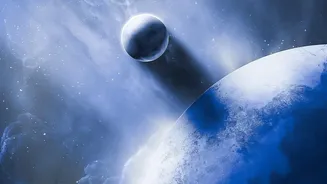
the Sun's corona in all directions. This wind is not a gentle breeze; it travels at incredible speeds, typically ranging from 300 to 800 kilometres per second. By the time it reaches our planet, it is a relentless force, carrying with it a part of the Sun’s own magnetic field. Without a planetary shield, this constant bombardment is capable of stripping an atmosphere away into space, a fate that scientists believe befell Mars long ago.
Earth's Built-in Force Field
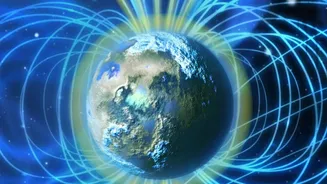
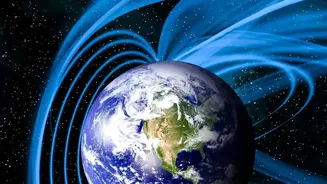
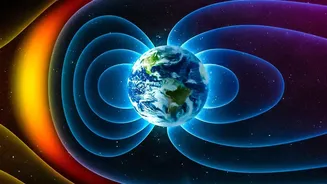
Fortunately, Earth has a powerful defense. Deep within our planet, the churning motion of molten iron in the outer core acts like a gigantic dynamo, generating a massive magnetic field. This field extends tens of thousands of kilometres into space, creating a protective bubble known as the magnetosphere. If space were empty, this field would look like the neat, symmetrical lines around a simple bar magnet. But space is not empty; the solar wind is always pushing against it. It is this epic collision between the solar wind and our magnetic field that defines the magnetosphere's true shape and function.
The Tear-Drop Shape
When the high-speed solar wind slams into Earth's magnetic field, it creates a shockwave, much like the bow wave of a boat moving through water. The immense pressure compresses the magnetosphere on the side facing the Sun, squashing it down. On this 'dayside', the boundary of our magnetic shield, called the magnetopause, is pushed to within about 65,000 kilometres of Earth. Conversely, on the 'nightside', away from the Sun, the solar wind stretches the magnetosphere out into an incredibly long tail, much like a windsock in a gale. This tail, known as the magnetotail, extends for millions of kilometres, well beyond the orbit of the Moon. This process of being squashed on one side and stretched on the other is what gives our magnetosphere its distinct, comet-like teardrop shape.
Our Planetary Shield in Action
This teardrop shape is not just a curiosity; it is the sign of our planet's shield actively defending us. The magnetosphere deflects the vast majority of the charged particles from the solar wind, forcing them to flow around the Earth instead of bombarding our atmosphere directly. This protection is crucial for life. Without it, the solar radiation would erode our atmosphere, damage our DNA, and make the surface of the planet uninhabitable. While the shield is highly effective, it is not perfectly impenetrable. Some particles manage to leak through, especially near the poles where the magnetic field lines funnel downwards into the atmosphere. This is where the story of our shield has a beautiful consequence.
A Beautiful Side Effect: The Aurora
Those solar particles that do enter our magnetosphere are guided by magnetic field lines towards the polar regions. There, they collide with oxygen and nitrogen atoms in the upper atmosphere. These collisions excite the atmospheric gases, causing them to glow in a spectacular display of coloured light. This is the aurora—the Northern and Southern Lights. The vibrant greens, reds, and purples that dance across the polar skies are the visible evidence of our magnetic shield at work, intercepting energetic particles from the Sun. They serve as a stunning reminder of the powerful, unseen battle that constantly rages high above our heads, keeping our world safe and alive.