



The Fiery Problem of Re-Entry
Any object entering a planet's atmosphere at high speed faces immense challenges. A spacecraft returning from deep space can hit the top of the atmosphere at speeds exceeding 18,000 miles per hour. This incredible velocity compresses the air in front
of the vehicle, creating a shockwave with temperatures that can reach thousands of degrees—hot enough to melt most metals. Traditional heat shields have been rigid, built to fit within the constraints of a rocket's launch fairing. This size limitation directly impacts how much mass can be safely landed, a major hurdle for missions requiring heavy equipment, like sending humans to Mars.
An Inflatable, Game-Changing Solution
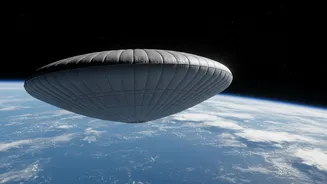
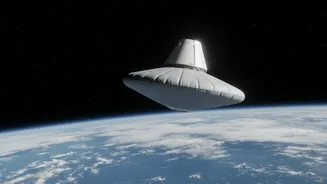
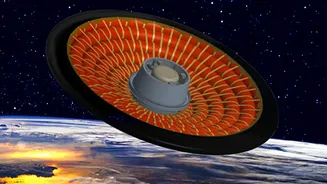
Inflatable heat shields, or Hypersonic Inflatable Aerodynamic Decelerators (HIADs), are designed to overcome this size limitation. Because they are made of flexible materials, they can be packed into a small volume for launch. Once in space, just before atmospheric entry, the shield inflates to a diameter much larger than any conventional rigid shield could be. This seemingly simple change has profound implications. The larger surface area creates significantly more drag, allowing the spacecraft to begin slowing down much higher in the atmosphere where the air is thinner. This leads to a gentler deceleration and less intense heating.
Built to Withstand Extreme Heat
At first glance, an inflatable object might seem too fragile for the rigors of re-entry. However, these are not simple balloons. The structure is built from a series of stacked, concentric rings, or tori, woven from synthetic fibers that are, by weight, ten times stronger than steel. This structure is what gives the shield its shape and strength when inflated with nitrogen gas. To protect this inflatable core, it's covered by a sophisticated flexible thermal protection system. The outermost layer is a woven ceramic fabric made from silicon carbide fibers that can withstand temperatures over 1,600 degrees Celsius. Beneath this are multiple layers of high-tech insulation to prevent heat from reaching the inflatable structure.
Proven in the Real World: The LOFTID Mission
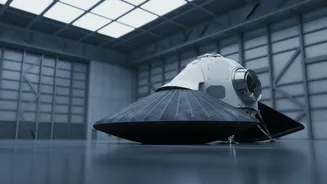
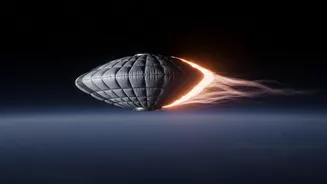
This technology is not just theoretical. NASA successfully demonstrated its capabilities with the Low-Earth Orbit Flight Test of an Inflatable Decelerator (LOFTID) mission. Launched as a secondary payload, the 6-meter diameter LOFTID vehicle inflated in orbit and successfully re-entered Earth's atmosphere. It survived the intense heat and dynamic pressure of hypersonic flight, splashing down safely in the Pacific Ocean where it was recovered. The test proved that the inflatable aeroshell could effectively protect a payload and perform stably during its fiery descent, validating over a decade of development. The success of LOFTID moved the technology from an experimental concept to a proven system ready for future missions.
Unlocking the Future of Space Exploration
The primary advantage of inflatable heat shields is their ability to land heavier payloads. Current rigid heat shield technology limits Mars landings to about one metric ton. To land humans and the necessary habitats and supplies, payloads of 20 metric tons or more will be required. Inflatable decelerators are a key enabling technology for this goal. Beyond Mars, they could be used to explore other worlds with atmospheres, like Venus or Saturn's moon Titan. They also open up possibilities for landing at higher-altitude sites on Mars, which are currently inaccessible because the thinner atmosphere doesn't provide enough braking for conventional systems. Furthermore, the technology could be used to recover valuable rocket stages and return large items from low-Earth orbit, reducing the cost of space access.