



In a landmark achievement for space science, a joint India-Europe effort involving the Aditya-L1 and Proba-3 missions has yielded the first precise measurements of the mass and density of solar eruptions right as they leave the Sun.
Two Missions, One Goal
This breakthrough is the
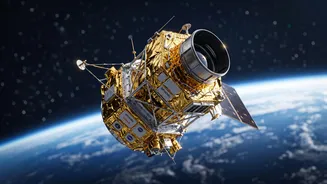
result of a powerful collaboration between two of the most advanced solar observation missions. India's Aditya-L1, the nation's first dedicated solar observatory, is positioned 1.5 million kilometres from Earth, providing an uninterrupted view of the Sun. Its key instrument, the Visible Emission Line Coronagraph (VELC), is designed to study the Sun’s outer atmosphere, or corona, by analysing the light signatures of the plasma. The European Space Agency's (ESA) Proba-3 is a feat of engineering, comprising two satellites flying in perfect formation just 150 metres apart. One satellite blocks the Sun's bright face, creating a precise, long-lasting artificial eclipse. This allows the second satellite's coronagraph, ASPIICS, to capture incredibly detailed images of the inner corona, a region notoriously difficult to observe.
Decoding Violent Solar Outbursts
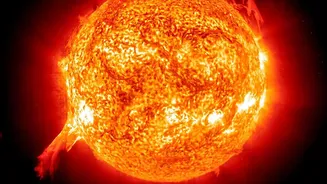
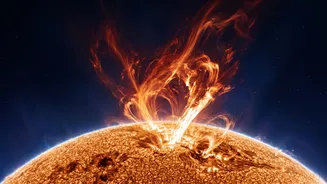
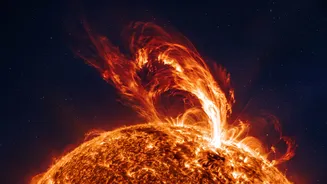
The Sun's surface is far from tranquil. It frequently unleashes colossal explosions of magnetised plasma known as Coronal Mass Ejections (CMEs). These solar eruptions can hurl billions of tonnes of material into space at immense speeds. While many miss our planet, an Earth-directed CME can have serious consequences. They can trigger intense geomagnetic storms that disrupt satellite operations, interfere with GPS and communication networks, and even threaten terrestrial power grids. Understanding what powers these events and accurately predicting their trajectory and impact is a crucial goal of modern space weather forecasting. However, a major challenge has been observing CMEs in their infancy, close to the Sun, to understand their initial properties.
A Symphony of Data
The recent joint observations focused on two CMEs that occurred in September 2025. By combining the capabilities of Aditya-L1 and Proba-3, scientists achieved a more complete picture than either mission could provide alone. Proba-3's ASPIICS instrument used its artificial eclipse to take sharp images of the eruptions, allowing researchers to determine the shape, speed, and overall mass of the ejected material. Simultaneously, Aditya-L1's VELC instrument performed spectroscopy on the light from the same event. This technique splits the light into its component parts, revealing vital information about the plasma's temperature, speed, and, crucially, its density. For the first time, scientists had two independent but complementary datasets for the same event, allowing them to cross-check their findings and build a comprehensive profile of the eruption's initial moments.
Why Mass and Density Matter
Knowing the mass and density of a CME right at the start is a game changer for space weather prediction. Think of it like trying to predict a hurricane's path and intensity. The more data you have about its initial formation—wind speed, pressure, size—the more accurate your forecast will be. Similarly, the initial mass and density of a CME determine its momentum and how it will interact with the solar wind as it travels through space. This information provides a crucial missing variable for the models that predict a CME's arrival time and potential geomagnetic impact on Earth. By accurately measuring these parameters, the Aditya L1 and Proba L3 team has provided the data needed to significantly improve the lead time and reliability of space weather warnings, helping to protect our increasingly technology dependent society.
A New Era for India Europe Cooperation
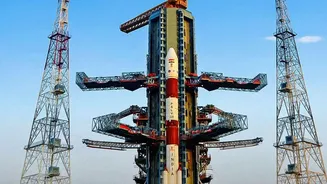
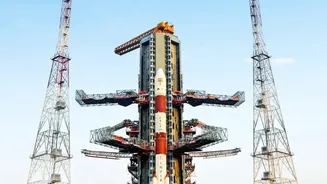
This scientific achievement also marks a high point in the growing space partnership between India and Europe. ESA's Proba L3 was even launched aboard an Indian PSLV rocket, highlighting the deep trust and collaboration between the agencies. Such partnerships are vital in modern space exploration, where combining resources and expertise allows for missions of a scale and complexity that would be difficult for any single nation to achieve. This successful joint observation campaign not only advances our understanding of the Sun but also solidifies a powerful international alliance in science, paving the way for future collaborative projects to explore the cosmos.