




A New Window to the Cosmos
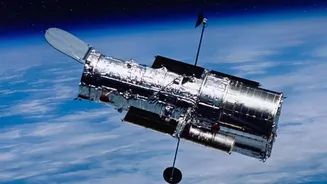
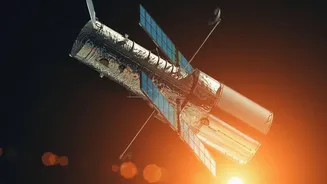
Set for a landmark launch on August 30, 2026, NASA's Nancy Grace Roman Space Telescope represents the next great leap in our quest to understand the universe. While it shares a primary mirror of the same size as the Hubble Space Telescope, Roman is engineered
for a profoundly different task. Its power lies not in zooming in on a single, tiny patch of sky, but in capturing vast cosmic panoramas. The telescope's Wide Field Instrument will have a field of view at least 100 times larger than Hubble’s, allowing it to map enormous swathes of the galaxy with incredible speed and precision. This isn't just an incremental upgrade; it’s a fundamental shift in how we survey the heavens. Instead of painstakingly stitching together small images over years, Roman will deliver breathtaking, high-resolution vistas of millions of galaxies in single snapshots, promising a firehose of data that will keep astronomers busy for decades.
The Great Planetary Census
For young people who grew up learning that our solar system has eight planets, Roman is poised to introduce them to a galaxy teeming with thousands more. The mission is expected to discover a staggering number of exoplanets—planets orbiting other stars—with some estimates reaching as high as 100,000 over its lifetime. This would dramatically expand our current catalogue of known worlds. It will achieve this primarily through a technique called gravitational microlensing. This method can detect planets much farther away and of much lower mass than previous surveys, including rogue planets that drift through space without a host star. Each new discovery isn't just a data point; it's a new world for the imagination. For every child who has ever wondered if there are other planets like Earth, Roman will provide a definitive answer: they are not just common, they are everywhere.
Shining a Light on Dark Mysteries
Beyond finding new worlds, Roman will tackle some of the deepest and most perplexing questions in all of science. Chief among them are the puzzles of dark energy and dark matter. These invisible components are believed to make up about 95% of the universe, yet we know almost nothing about them. Dark energy is the mysterious force causing the universe's expansion to accelerate, and dark matter is the unseen cosmic scaffolding upon which galaxies are built. By surveying over a billion galaxies, Roman will create a vast 3D map of the cosmos across space and time. By studying how galaxies are clustered and how their light is distorted by gravity, scientists can trace the influence of these dark components on the evolution of the universe. This quest to understand the fundamental nature of reality is exactly the kind of grand challenge that has always inspired young minds to pursue science, technology, engineering, and mathematics.
Paving the Way for Tomorrow's Explorers
Inspiration often comes from seeing what’s possible. Roman is equipped with a groundbreaking technology demonstrator called the Coronagraph Instrument, designed to block the overwhelming glare of a star to directly image the faint planets orbiting it. This instrument is at least 100 times more powerful than any previous facility and will serve as a crucial stepping stone for future missions, like the planned Habitable Worlds Observatory, which will be designed specifically to search for signs of life on Earth-like planets. By proving this technology in space, Roman is not just making its own discoveries; it is building the tools and techniques that the next generation of scientists will use. It sends a powerful message to students everywhere: the biggest discoveries are still ahead, and they have the chance to be the ones to make them.