



A Habitable Zone World
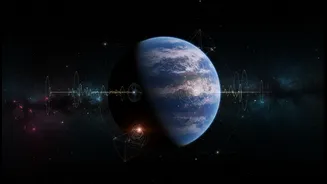
K2-18b is an exoplanet roughly 8.6 times the mass of Earth, located about 120 light-years away in the constellation Leo. Discovered in 2015, it has captivated astronomers because it orbits within its star's 'habitable zone'. This is the so-called 'Goldilocks'
region where conditions are just right—not too hot and not too cold—for liquid water to potentially exist on a planet's surface. Early observations with the Hubble Space Telescope and later, more detailed studies, suggested the presence of carbon-bearing molecules and water vapour, strengthening the case that K2-18b could be a special kind of world.
A 'Hycean' Planet?
Scientists have theorised that K2-18b could be a 'Hycean' world, a term coined by combining 'hydrogen' and 'ocean'. This describes a hypothetical type of planet with a vast, liquid-water ocean under a thick, hydrogen-rich atmosphere. The detection of methane and carbon dioxide in its atmosphere by the James Webb Space Telescope (JWST) supported this idea, as this combination is consistent with predictions for a water world. The possibility of a planet-wide ocean makes K2-18b a prime candidate in the search for extraterrestrial life, which, as far as we know, requires water to thrive. However, the existence of Hycean worlds is still a subject of scientific debate, with some models suggesting K2-18b might be a gas-rich mini-Neptune with no habitable surface at all.
The Hunt for Biosignatures
The latest excitement stems from observations made by the James Webb Space Telescope, which analysed the starlight filtering through K2-18b's atmosphere. This technique allows scientists to identify the chemical composition of the air on this distant world. In this data, a team of researchers reported the possible detection of dimethyl sulfide (DMS), a molecule that, on Earth, is overwhelmingly produced by life, particularly marine microorganisms like phytoplankton. This potential 'biosignature' was a groundbreaking hint, as it represented one of the strongest clues yet for biological processes on an exoplanet. The detected levels were also thousands of times stronger than those on Earth, which, if confirmed, could imply a planet teeming with microbial life.
Listening for an Answer
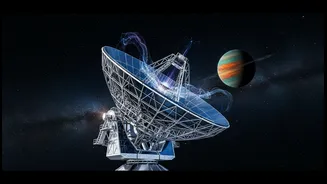
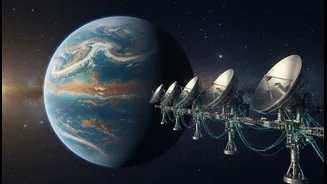
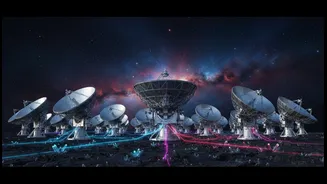
While JWST was looking for chemical clues, another major effort focused on a different kind of signal. The headline's 'massive radio survey' refers to a recent project where scientists used two of the world's most powerful radio telescope arrays—the Very Large Array (VLA) in the US and MeerKAT in South Africa—to scan K2-18b for artificial radio transmissions. This was a Search for Extraterrestrial Intelligence (SETI) campaign, listening for 'technosignatures' that might indicate an advanced civilisation. The powerful, coordinated search sifted through millions of potential signals, but after filtering out Earth-based interference, found no convincing evidence of alien technology.
Caution, Debate, and the Path Forward
Despite the initial excitement, the scientific community remains cautious. The detection of DMS is not yet considered definitive, as the signal is weak and other independent analyses have questioned the finding, suggesting it could be statistical noise. Scientists also point out that even if DMS is present, there might be unknown geological or chemical processes on an alien world that could produce it without life. The null result from the SETI radio survey also means we have no evidence of technology. The debate highlights the immense challenge of confirming life from light-years away. For now, K2-18b remains a fascinating puzzle. Future observations with JWST are planned to gather more data, which scientists hope will finally confirm or deny the presence of DMS and give us a truly clearer picture of this intriguing world.