





Meet the Seven Sisters
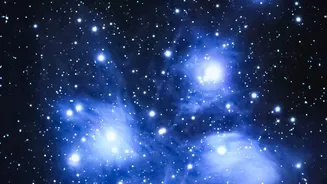
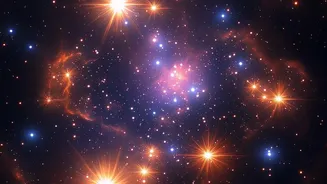
Often mistaken for a tiny dipper, the Pleiades, also known as the Seven Sisters or M45, is an open star cluster located about 440 light-years away in the constellation of Taurus. While its nickname suggests seven stars, the cluster actually contains over
a thousand. To the naked eye, most people can spot a fuzzy patch with six or seven distinct points of light. These are the cluster's brightest members—young, incredibly hot, and luminous blue stars that formed from the same cloud of gas and dust around 100 million years ago. This shared origin makes them a true stellar family, drifting through space together.
Legends in the Stars
The Pleiades' visibility from nearly everywhere on Earth has made it a cornerstone of mythology across countless cultures. In Greek legend, the stars represent the seven daughters of the Titan Atlas and the sea-nymph Pleione. Pursued by the relentless hunter Orion, the sisters were transformed into doves and placed in the sky by Zeus for their protection. To this day, the constellation of Orion is said to still chase the sisters across the night sky. In Japan, the cluster is known as 'Subaru,' meaning 'unite,' a name famously adopted by the car manufacturer, whose logo depicts six of the stars.
Your Guide to Spotting the Pleiades
According to NASA's skywatching guide, October is a fantastic time to view the Pleiades as they become prominent in the evening sky. Throughout the month, the cluster rises in the east in the evening and climbs higher as the night goes on. A special celestial event occurs on the night of October 27th and into the morning of the 28th, when the Moon will pass very close to the star cluster, making for a beautiful pairing. To find them, look for the constellation Orion and its famous three-star belt. Follow the line of the belt upward until you reach a bright, reddish star named Aldebaran, the eye of Taurus the bull. Continue just beyond Aldebaran, and you'll find the tight, shimmering group of stars that is the Pleiades.
Tips for the Best View
While the Pleiades are visible even from light-polluted areas, your viewing experience will be greatly enhanced by finding a dark location away from city lights. Allow your eyes about 20 to 30 minutes to fully adjust to the darkness; this will help you spot fainter stars. The cluster is a wonderful naked-eye object, appearing as a small, misty patch. However, even a simple pair of binoculars will transform the view, revealing dozens, if not hundreds, of glittering stars and resolving the cluster's dense nature. A telescope will offer an even closer look, and under dark skies, may even reveal the faint, bluish haze of interstellar dust that the stars are currently passing through, known as a reflection nebula.