




Meet the Robotic Workforce on Mars
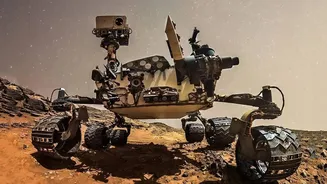
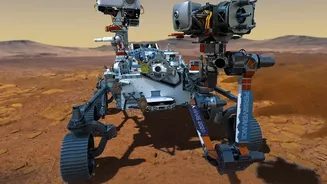
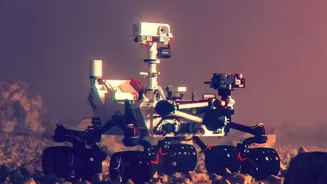
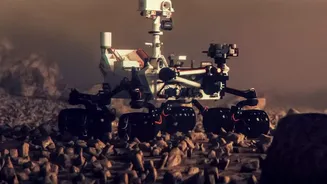
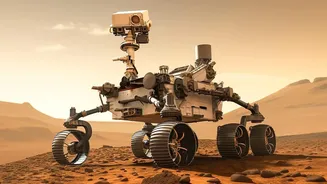
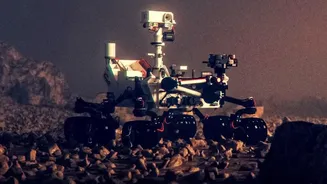
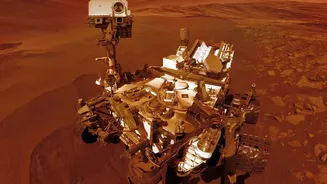
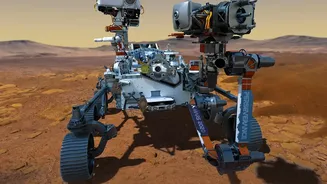
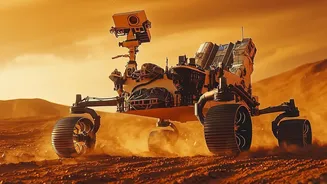
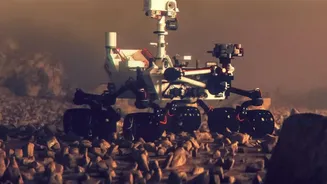
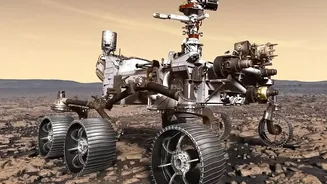
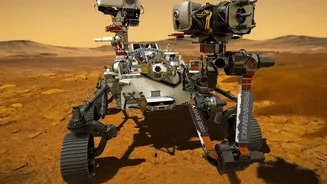
As of late 2026, the Martian surface is the exclusive domain of robotic explorers. NASA's Perseverance and Curiosity rovers are the two primary active missions on the ground. The Perseverance rover, which landed in 2021, is actively searching for signs
of ancient life in Jezero Crater and has collected numerous rock and soil samples. Recent discoveries include the confirmation of complex organic carbon in rocks, a tantalizing clue that the building blocks of life may have once been widespread. Meanwhile, the Curiosity rover, a veteran that has been exploring Gale Crater since 2012, continues to climb Mount Sharp, studying the planet's geological and climate history. Having operated for over a decade, far beyond its initial mission, Curiosity has provided definitive evidence that Mars once had conditions suitable for microbial life. These robotic geologists are slow but incredibly persistent, capable of working for years in an environment that would be lethal to an unprotected human.
The Case for the Machine
The arguments for prioritizing robotic exploration are compelling and pragmatic. First and foremost is safety. Sending a robot eliminates the immense risk to human life from launch failures, radiation exposure during the months-long journey, and the perils of landing and surviving on a hostile world. Second is cost. A human mission to Mars is estimated to cost orders of magnitude more than a robotic one, largely due to the need for life support, food, water, and return-trip capabilities. The Perseverance rover cost around $2.7 billion, whereas a crewed mission could run into the hundreds of billions. Robots are also marathon runners; they don't get tired or require life support, allowing for missions that last for years or even decades. They can be sent to more hazardous regions and can be designed for highly specific scientific tasks, carrying suites of instruments too delicate or specialized for a general-purpose human mission.
The Irreplaceable Human Touch
Despite the strengths of rovers, there is a strong case that true exploration requires human presence. The greatest advantage humans have is adaptability and speed. A human geologist could accomplish in a single day what might take a rover an entire year. They can react to unexpected discoveries in real-time, pivot an investigation, and use intuition to solve problems. While a rover must be painstakingly guided from millions of miles away to avoid a rock, a human can simply walk around it. Tasks like digging a trench, which can take a robotic probe months of effort, could be done by an astronaut with a shovel in minutes. Furthermore, many scientists argue that identifying definitive proof of past life, such as fossilized microbes, will require humans on the ground to break open countless rocks and analyze them with a level of nuance a robot cannot match. Finally, human missions have an unparalleled ability to inspire the public and drive educational and technological advancement.
A Partnership, Not a Competition
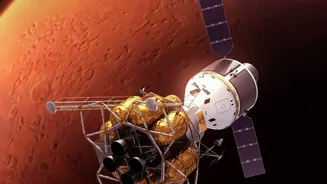
The 'robots versus humans' framing is increasingly seen as a false choice. The modern approach to Mars exploration views it as a symbiotic partnership. Robotic missions are the essential precursors that map the terrain, identify resources like water ice, analyze atmospheric conditions, and test key technologies needed for human survival. For example, the MOXIE experiment aboard the Perseverance rover has already demonstrated that it's possible to produce oxygen from the Martian atmosphere, a critical step for future human bases. The samples being collected by Perseverance were intended for a sophisticated robotic sample-return mission that would bring them to Earth for study in advanced laboratories. Although that specific mission, Mars Sample Return (MSR), was cancelled due to cost overruns, NASA is already developing a new strategy to retrieve these invaluable samples, recognizing that some science can only be done on Earth. These robotic efforts directly reduce the risks for future human explorers.