






The Age-Old Challenge of Monsoon Prediction
The Indian monsoon is a complex weather system that delivers about 75% of the country's annual rainfall. Its arrival is vital for agriculture, a sector that supports nearly half of all Indians. For centuries, forecasting its onset and behaviour has been
a monumental challenge. Traditional numerical weather prediction (NWP) models, which simulate the atmosphere using physics equations on supercomputers, can provide broad guidance but struggle with reliable, detailed forecasts more than five days out. This leaves farmers, especially the millions of smallholders, vulnerable to the whims of a changing climate, which is making the monsoon even more erratic. An ill-timed sowing can lead to devastating losses, impacting livelihoods and national food security.
The AI Advantage: A New Era of Forecasting
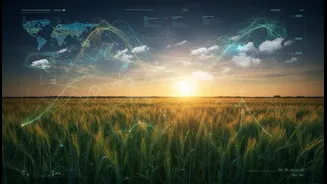
Artificial intelligence offers a fundamentally different approach. Instead of simulating atmospheric physics from scratch, AI models are trained on decades of historical weather data. They learn to recognise complex patterns and correlations that are often invisible to traditional methods. By comparing current conditions to past events, models like Google's NeuralGCM can predict outcomes with greater speed and efficiency. This method is not only faster but can also be run on high-end laptops instead of supercomputers, a development described as the "democratisation of weather forecasting." In a major initiative, a blend of AI models successfully predicted the monsoon's onset up to a month in advance, even capturing an unusual 20-day stall in the season that traditional models missed.
From Data Points to Decisive Action
The true impact of this technology is felt on the ground. Through partnerships between organisations like the University of Chicago, Google Research, and India's Ministry of Agriculture and Farmers' Welfare, these advanced forecasts are being delivered directly to farmers. In a recent project, 38 million farmers received tailored forecasts via SMS. This information empowers them to make critical, timely decisions: when to sow seeds, whether to buy more inputs, if they should switch to a different crop, or simply wait for more favourable conditions. For instance, knowing the precise timing of sustained rains allows farmers to avoid planting seeds that might fail in a dry spell, saving precious resources. Studies have shown that access to such advanced forecasts can significantly improve outcomes, with one analysis suggesting it could nearly double a farmer's annual income.
Hyperlocal Predictions for Hyperlocal Needs
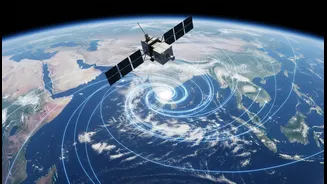
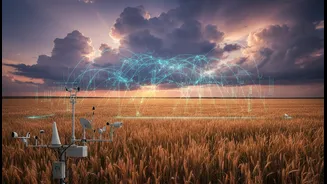
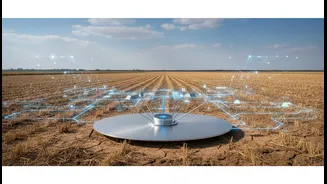
The India Meteorological Department (IMD) is also heavily incorporating AI into its services. For the first time, the IMD has launched AI-enabled models that can predict the monsoon's progression at the block level up to four weeks in advance. A pilot project in Uttar Pradesh aims to provide rainfall forecasts with a high-resolution of just one kilometre, a massive improvement from the previous 12.5 km scale. This hyperlocal precision is generated by combining data from automatic rain gauges, weather stations, and satellites, then using AI to downscale it for local relevance. Getting such specific information helps farmers plan everything from irrigation schedules to the application of pesticides with much greater confidence.
Overcoming Hurdles to Widespread Adoption
Despite the immense potential, several challenges remain. The effectiveness of AI models is entirely dependent on the quality and availability of vast amounts of data. In rural India, inadequate digital infrastructure, including poor internet connectivity, can be a significant barrier. Furthermore, there are social hurdles to overcome, such as low digital literacy rates among some farmers and a lack of trust in new technologies. For AI to be truly transformative, it must be accompanied by robust farmer training, accessible platforms, and a concerted effort to bridge the digital divide. Building public data ecosystems and fostering collaboration between government bodies, research institutions, and private agri-tech firms will be crucial for scaling these solutions nationwide.