


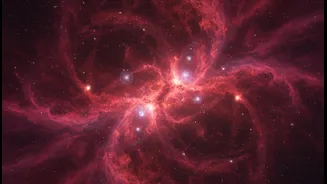
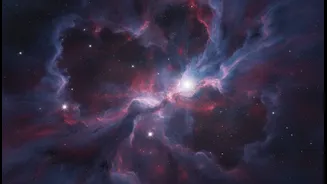


Meet the 'Crimson Nebula'
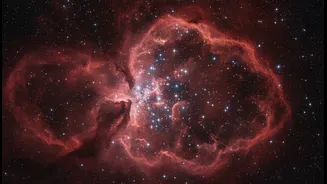
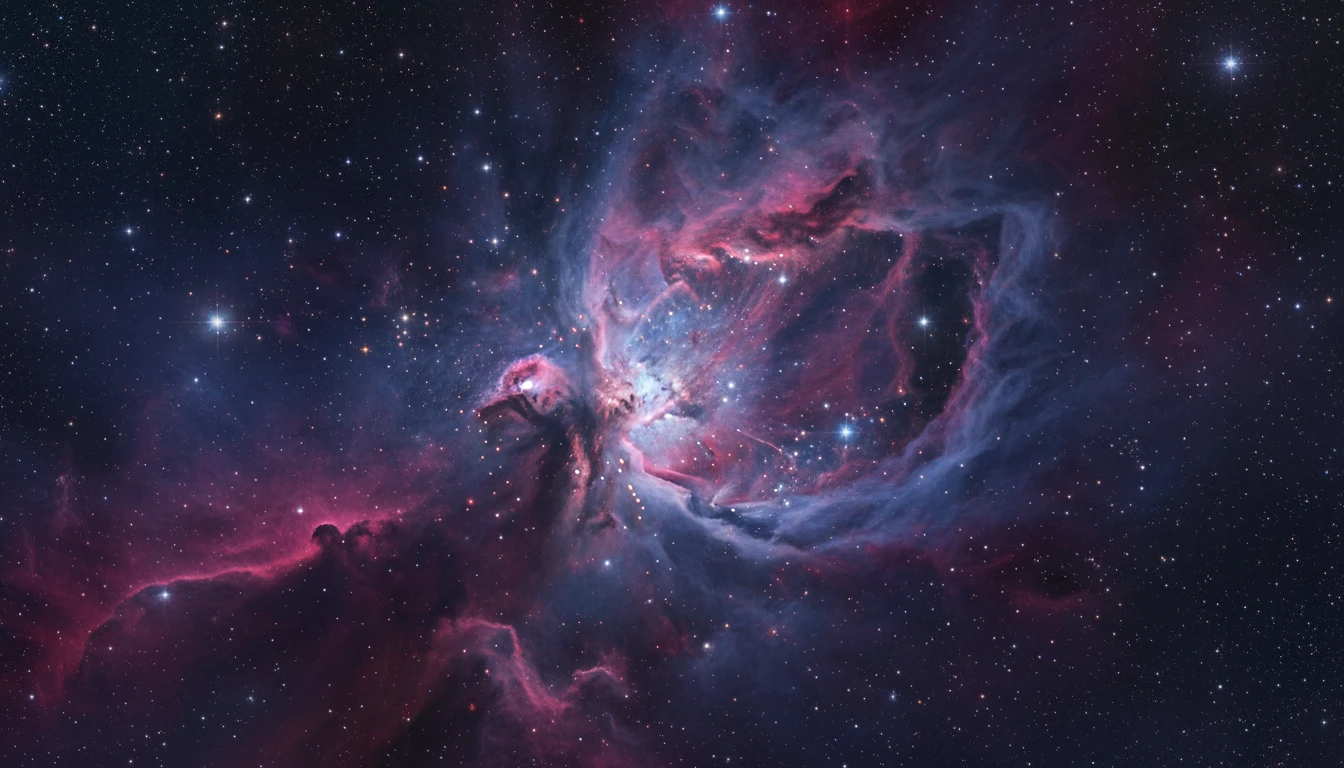
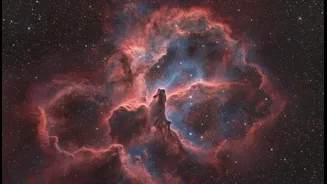
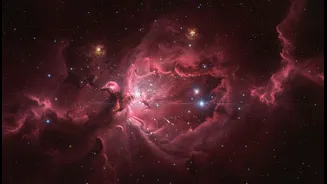
The subject of this stunning new portrait from the Hubble Space Telescope is a stellar nursery officially known as LH 95. Located in the Large Magellanic Cloud, a small satellite galaxy that orbits our own Milky Way, this region is a chaotic and beautiful
landscape of gas and dust. The name 'Crimson Nebula' isn't official, but a perfect description given by space agencies themselves. The brilliant red glow comes from vast clouds of hydrogen gas. This gas is superheated by the intense radiation pouring from massive, young blue stars, causing it to emit light in a specific red wavelength called hydrogen-alpha. Think of it as a cosmic neon sign, except instead of advertising a diner, it's announcing the birth of thousands of new stars.
A Cosmic Maternity Ward
The real significance of LH 95 lies in what's happening inside. It's a bustling stellar nursery, and Hubble's sharp vision has given astronomers an unprecedented look at the star-birthing process. The image reveals a staggering 2,500 'pre-main-sequence' stars. These are essentially baby stars, celestial toddlers that have gathered almost all of their mass but have not yet ignited nuclear fusion in their cores—the step that will make them true, stable stars. By studying so many of these developing stars in one place, scientists can understand a critical and fleeting phase of stellar evolution, gathering clues about how long it takes for stars to grow and switch on.
More Than a Single Story
One of the most exciting discoveries within LH 95 is that star formation is not happening in one single burst. Instead, astronomers see multiple generations of stars living side-by-side. Older, more massive stars are sculpting the nebula with their powerful stellar winds and radiation, creating dense pockets and filaments of dust. These compressed areas can then collapse under their own gravity, triggering a fresh wave of star birth. This process of stellar feedback, where one generation of stars helps create the next, is a key mechanism for how galaxies evolve. Seeing it in action in LH 95 provides a real-world test for our theories about how star formation can sustain itself over millions of years.
Why It Matters For Us
Looking at a nebula 163,000 light-years away might seem abstract, but it connects directly to our own origins. Our sun was also born in a stellar nursery billions of years ago. By studying regions like LH 95, we are essentially looking at a snapshot of the kind of environment where our own solar system may have formed. These cosmic clouds of gas and dust are where the raw materials for planets are found. Furthermore, because the Large Magellanic Cloud has less obscuring dust than our own galaxy, it offers a clearer laboratory to watch these processes unfold. Each image from Hubble isn't just a pretty picture; it’s a page from the universe's autobiography, helping us piece together the grand story of cosmic creation and, ultimately, our own place within it.