

The Blinding Challenge of Starlight
Taking a picture of an exoplanet is one of the hardest tasks in astronomy. The fundamental problem is one of contrast and distance. A planet is billions of times fainter than the star it orbits, and from our perspective, it is incredibly close to that
star's blinding glare. Trying to spot one is often compared to trying to see a tiny firefly buzzing next to a colossal searchlight from kilometres away. Because of this, nearly all of the thousands of exoplanets discovered to date have been found indirectly. Methods like transit photometry, which detects the slight dimming of a star as a planet passes in front of it, and radial velocity, which measures the gravitational tug a planet exerts on its star, tell us that planets are there, but they don't give us a picture.
Blocking the Glare with Cosmic Sun Visors
The most straightforward approach to direct imaging is to block the starlight. Future and current observatories, like NASA’s Nancy Grace Roman Space Telescope, are being equipped with incredibly advanced instruments called coronagraphs. A coronagraph works like a highly sophisticated sun visor inside a telescope, precisely occulting the light from the star to reveal the much fainter planet orbiting nearby. These instruments are technological marvels, capable of suppressing starlight to unprecedented levels. However, even with these powerful tools, we are limited. They are best suited for imaging large, young, gas-giant planets that are orbiting very far from their host stars. Getting a clear look at a small, rocky, Earth-like planet remains beyond the reach of this technology alone.
Nature's Ultimate Telescope
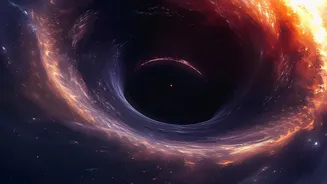
To achieve the seemingly impossible, scientists are turning to one of the most profound concepts in physics: gravitational lensing. First predicted by Albert Einstein, this effect describes how massive objects warp the fabric of spacetime, causing light to bend as it passes by. In a concept known as the Solar Gravitational Lens (SGL), our own Sun could be used as a gargantuan natural telescope. Its immense gravity could magnify the light from a distant exoplanet, creating resolving power and brightness amplification far beyond what any human-built telescope could ever achieve. The SGL offers a brightness gain of a factor of 100 billion and an angular resolution that is almost unimaginably sharp.
A Mission to the Deepest Dark
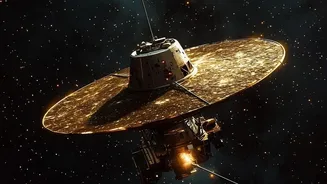
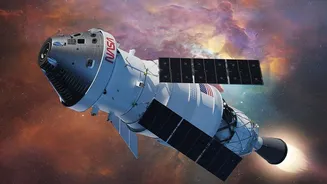
Harnessing this power requires a journey to the focal line of the lens. A space probe equipped with a modest, meter-class telescope would have to travel to a point starting at least 550 Astronomical Units (AU) from Earth—one AU is the distance from the Earth to the Sun. To put that in perspective, the Voyager 1 spacecraft, which has been travelling for nearly 50 years, is only about 160 AU away. This mission would require a probe to travel farther and faster than any object ever launched from Earth. Researchers at NASA's Jet Propulsion Laboratory are studying concepts for this, proposing that advanced solar sails could propel a spacecraft to this region in under 20 years.
Painting a Picture, Pixel by Pixel
Once it arrives in the focal region, the probe wouldn't just take a single snapshot. The magnified light from the exoplanet would appear as a distorted ring of light around the Sun, known as an Einstein Ring. The spacecraft would have to move precisely through this region, taking thousands of measurements of this ring. Each measurement would act like a single pixel. Over several months, these pixels would be computationally reconstructed into a complete, multi-pixel image of the exoplanet. The potential resolution is astonishing. A six-month observation could yield an image with a resolution of just a few kilometres per pixel, detailed enough to distinguish continents, oceans, and cloud cover on a world light-years away.
The Long Road Ahead
The challenges for such a mission are, appropriately, astronomical. The propulsion required to reach the SGL focal line in a reasonable timeframe is immense. Navigation would have to be exquisitely precise, and transmitting vast amounts of data back to Earth across such distances is a monumental hurdle. Furthermore, the mission would take decades from launch to completion. Despite these difficulties, the Solar Gravitational Lens concept represents the most scientifically plausible method for one day seeing another Earth. It's a testament to human ingenuity that we can envision turning our own star into the lens for the greatest observatory ever conceived.