



More Than Just Standing
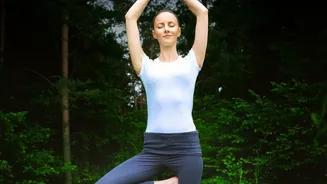
Tadasana, from the Sanskrit 'tada' (mountain) and 'asana' (pose), is the blueprint for all other standing poses. It teaches the body how to stand with optimal alignment, creating stability, strength, and steadiness. In a world where we spend hours slouched
over desks and phones, our natural posture is often compromised, leading to discomfort and strain. Mountain Pose acts as a powerful corrective measure, training your body and mind to recognise what it feels like to stand tall and aligned, reducing the burden on your muscles and allowing your skeleton to support your weight efficiently.
A Step-by-Step Guide to Tadasana
Finding your true Mountain Pose requires mindful engagement from head to toe. Here is a guide to help you build the pose from the ground up: 1. Establish Your Foundation: Stand with your feet either hip-width apart or with your big toes touching and heels slightly apart. Lift and spread your toes to feel the ground, then lower them back down. Press down firmly through the four corners of your feet: the mounds of the big and little toes, and the inner and outer heels. 2. Engage Your Legs: Gently lift your kneecaps to activate your quadriceps without locking your knees. Imagine a slight inward rotation of your thighs. This subtle action helps to stabilize the pelvis. 3. Align Your Spine: Draw your tailbone down slightly toward your heels as you gently lift your lower belly. This creates a neutral pelvis and supports the lower back. Lengthen through your entire spine, imagining a straight line from your heels to the top of your head. 4. Open Your Chest: Roll your shoulders up, back, and then down, allowing them to relax away from your ears. Let your arms rest by your sides with your palms facing forward. This broadens the collarbones and opens the chest for deeper breathing. 5. Relax and Breathe: Keep your chin parallel to the floor to lengthen the back of your neck. Soften your gaze and your jaw. Stand tall and breathe deeply for 5-10 breaths, feeling both grounded and lifted.
Common Mistakes to Avoid
To get the full benefits of Tadasana, be mindful of common misalignments. A frequent error is locking the knees, which strains the joints and can impede blood flow. Always maintain a micro-bend in your knees. Another common issue is uneven weight distribution in the feet; ensure you are not leaning forward, backward, or onto the inner or outer edges. Avoid tensing the shoulders up toward your ears or excessively arching your lower back. The goal is a neutral, stacked alignment, not a rigid, tense stance. Lastly, remember to breathe. Holding your breath creates tension, whereas deep, steady breathing promotes calm and focus.
The Deeper Benefits of Awareness
The true power of Mountain Pose lies in its ability to cultivate proprioception, or body awareness. By paying close attention to the subtle muscular engagements and alignment points, you are training your nervous system. This practice enhances your balance and stability, which is crucial as you age. Studies have shown that mindfulness-based yoga practices can help reduce stress and anxiety, and Tadasana provides a perfect opportunity to ground yourself in the present moment. Standing with good posture can even boost your mood and self-confidence. This heightened awareness doesn’t just stay on the yoga mat; it translates into how you carry yourself throughout the day.