



The Solar System’s Most Valuable Resource
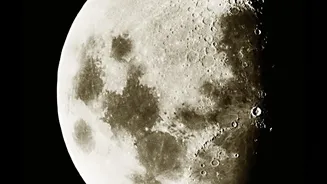
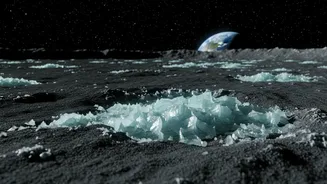
For decades, the Moon was thought to be a bone-dry desert. But a series of missions, including India’s own Chandrayaan-1, confirmed the presence of water in the form of ice, locked away in craters at the lunar poles that haven't seen sunlight in billions
of years. This discovery ignited a new space race, but not for flags and footprints. This race is for resources. Water-ice is considered the key to unlocking a permanent human presence on the Moon and enabling deeper voyages into the solar system. When broken down into its constituent parts, hydrogen and oxygen, it becomes powerful rocket propellant. The ability to refuel spacecraft on the Moon would be revolutionary, turning our celestial neighbour into a strategic launchpad to Mars and beyond. This concept, known as in-situ resource utilization (ISRU), could slash the astronomical cost of space exploration by allowing missions to 'live off the land' instead of hauling everything from Earth.
The Challenge of Eternal Darkness and Cold
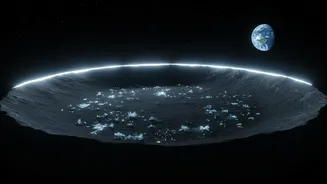
Harvesting this lunar ice is an immense engineering challenge. The resource is concentrated in Permanently Shadowed Regions (PSRs), some of the coldest places in the entire solar system. Temperatures here can plummet to an unimaginable minus 248 degrees Celsius. At this extreme cold, materials become brittle, lubricants fail, and electronics struggle to survive. Furthermore, the very nature of these craters means they are pitch-black, ruling out the use of solar panels to power a rover or mining equipment. Any mission venturing into a PSR must carry its own power source, navigate treacherous and poorly mapped terrain, and operate machinery in an environment far harsher than anything on Earth.
ISRO’s Plan: A Joint Exploration
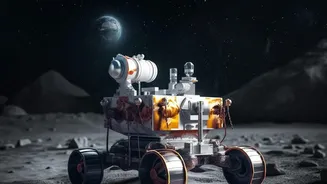
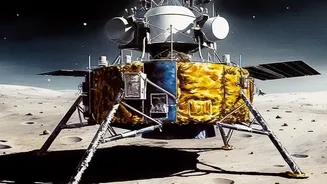
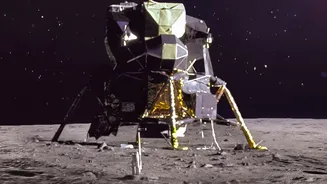
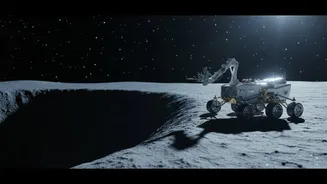
ISRO’s strategy centres on the ambitious Lunar Polar Exploration Mission (LUPEX), a joint venture with the Japan Aerospace Exploration Agency (JAXA) planned for launch around 2028. While the headline mission is exploration, not full-scale extraction, it is designed to develop and prove the very technologies needed for future mining. In this partnership, ISRO is developing the lander that will safely deliver the mission to the lunar surface, while JAXA is building the sophisticated, 350-kg rover. The rover is a mobile laboratory designed to answer critical questions: exactly where is the ice, how deep is it, how pure is it, and how is it mixed with the lunar soil, or regolith? Recent studies, including those using data from ISRO's Chandrayaan-2 orbiter, suggest there could be 5 to 8 times more ice just beneath the surface than on it, making drilling essential.
The Technology of Extraction
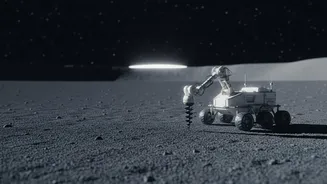
The LUPEX rover will be equipped with a suite of advanced tools from multiple space agencies, including NASA and ESA. A key component will be a drill capable of penetrating up to 1.5 meters below the frozen ground to pull up core samples of the icy regolith. Once a sample is collected, it will be analysed by a host of onboard instruments. This is where the 'extraction' begins. The prevailing method being developed is thermal. In simple terms, the plan is to heat the icy soil. One concept involves heating the sample in a contained 'oven' on the rover. As the temperature rises, the water-ice turns directly into vapour, a process called sublimation. This water vapour can then be piped to a separate, cold container where it refreezes as pure ice, separated from the dust and rock. The LUPEX rover will carry instruments like an ISRO-provided thermal probe to help quantify the ice in the samples, a critical step in proving this extraction technique can work.
From Science to a Lunar Economy
The goal of LUPEX is to create a detailed map of the Moon’s water resources, paving the way for future, larger-scale missions. Proving that water can be efficiently extracted is the first step toward building the infrastructure for a true lunar economy. Future automated probes and robotic systems, building on the lessons learned from LUPEX, would be tasked with extracting water not for analysis, but in industrial quantities. This harvested water would then be processed at a lunar facility, likely using electrolysis powered by solar arrays placed in nearby sunlit areas. The resulting oxygen and hydrogen could be stored as liquid propellant for spacecraft. Successfully developing this technology will not only cement India’s position as a leading space-faring nation but will also be a giant leap for humankind, providing the essential building blocks for establishing a sustainable, long-term presence beyond Earth.