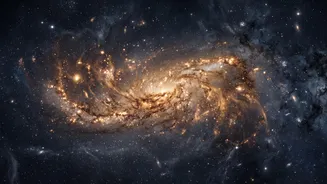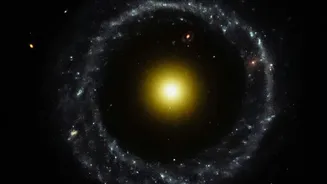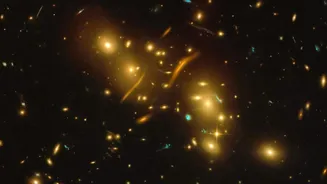

For decades, we’ve been told that 95% of our universe is made of mysterious 'dark matter' and 'dark energy'. Now, a new study from scientists in Ottawa is challenging that standard view with a model that doesn't need them at all.
The Universe We Thought We Knew
To understand why this
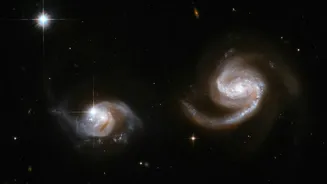
new idea is so radical, we first need to appreciate the standard story of the cosmos, known as the Lambda-CDM model. For years, scientists have faced a cosmic puzzle: galaxies spin so fast they should fly apart, and the expansion of the universe is inexplicably speeding up. The solution was to propose two invisible components. 'Dark matter' is the mysterious, unseen mass whose extra gravity supposedly holds galaxies together. 'Dark energy' is the placeholder name for the strange force pushing everything apart, causing the universe's accelerated expansion. Even though neither has ever been directly detected despite decades of searching, these two ideas have become fundamental to modern cosmology.
A Radical New Proposal from Ottawa
Enter Rajendra Gupta, an adjunct professor of physics at the University of Ottawa. Along with postdoctoral researcher Dr. Nikolaos Samaras, he has been testing an alternative model that neatly does away with the need for both dark matter and dark energy. Their model is called CCC+TL, which stands for 'Covarying Coupling Constants' and 'Tired Light'. In simple terms, it proposes two things. First, the fundamental forces of nature (like gravity) might not be constant; they could be weakening as the universe expands. Second, light may lose energy as it travels over billions of light-years, a concept known as 'tired light'. Together, these ideas paint a very different picture of cosmic history.
What a 'Dark'-Free Universe Looks Like
In the CCC+TL model, the effects we attribute to dark matter and dark energy are just illusions created by these changing physical laws. The weakening forces can mimic the effect of dark energy, causing cosmic expansion to appear to be accelerating. At the same time, this framework of evolving constants can explain the extra gravity holding galaxies together without needing to invent a new type of invisible matter. A major consequence of this model is that the universe would be much older than we thought. Instead of 13.8 billion years, the CCC+TL model calculates the age of the cosmos to be around 26.7 billion years.
Putting the Theory to the Test
A good scientific model must match observations. Gupta and his team have spent the last couple of years testing their CCC+TL framework against several key cosmological measurements. In a paper published in the Monthly Notices of the Royal Astronomical Society, they showed their model could reproduce the rotation speeds of 175 different galaxies without invoking dark matter. The model also successfully predicted the abundance of light elements created just after the Big Bang and aligned with measurements of cosmic expansion. It also solves a major headache posed by the James Webb Space Telescope, which has spotted galaxies in the early universe that look too mature for their supposed age. In a 26.7-billion-year-old universe, these 'impossible' early galaxies suddenly have plenty of time to form.
An Uphill Scientific Battle
While these initial results are promising, challenging a 50-year-old scientific consensus is a monumental task. The Lambda-CDM model, despite its gaps, successfully explains many other observations, including the fine details of the cosmic microwave background—the afterglow of the Big Bang. Gupta's model will need to pass this and many other tests to be taken seriously by the wider physics community. The researchers themselves label some of their findings, like an analysis of the Bullet Cluster, as an 'early proof of concept' that requires more study. The new model is not a final answer, but a compelling question mark that warrants further investigation.