




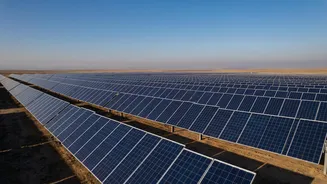
A Dazzling Success Story
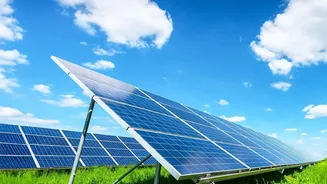
India's solar energy journey is nothing short of remarkable. In recent years, the country has massively scaled up its solar installations, becoming the world's third-largest solar power producer. By 2025, India had already achieved its goal of having
over 50% of its installed electricity capacity come from non-fossil fuel sources, a target met five years ahead of schedule. This has been driven by ambitious government policies, falling technology costs, and the development of massive solar parks in states like Rajasthan and Gujarat. This boom in generation has been crucial for meeting the country's rising energy demand and climate goals, fundamentally changing its energy landscape. For the first time, clean power is not just a supplement but a mainstream source capable of meeting huge portions of national demand.
The New Bottleneck: An Overwhelmed Grid
Imagine building a dozen new factories all connected to the same small road. During peak hours, that road becomes hopelessly jammed. This is essentially what is happening to India's electricity grid. The grid, our 'power highway', was not designed for the massive, simultaneous influx of electricity that solar farms produce during sunny afternoons. This creates a huge challenge. While solar generation surges midday, traditional power plants, like coal, cannot simply switch off and on quickly; they are inflexible. This mismatch means that grid operators, tasked with maintaining a stable frequency at all times, are often left with more power than the system can safely handle or transport. The problem, therefore, has shifted from a lack of generation to a lack of capacity to manage and transmit the generated power effectively.
The Cost of Congestion: Wasted Power
When the grid becomes overwhelmed, operators are forced to resort to a measure called 'curtailment'—essentially telling solar and wind farms to stop producing power, even when the sun is shining brightly. This isn't a small issue. In the last 15 months alone, India has curtailed nearly 11 terawatt-hours of solar generation, enough electricity to power about 10 million homes. This wasted energy represents a missed opportunity to displace fossil fuels and reduce emissions. Furthermore, it creates financial uncertainty for renewable energy producers. While some are compensated for this forced downtime, these costs are often passed on to consumers through electricity tariffs. Recent data shows curtailment is most severe in solar-rich states like Rajasthan and Gujarat, where on some days, projects face generation cuts of 50-60% during peak solar hours.
Building Bigger Power Highways
The long-term solution lies in a massive upgrade of India's transmission infrastructure. The government is focused on this through the Green Energy Corridor (GEC) project, a flagship program designed to create high-capacity transmission lines to move renewable power from energy-rich states to demand centers across the country. Phase I of the project is nearly complete, and Phase II aims to add thousands of circuit kilometers of transmission lines by 2026-27. Looking ahead, even more ambitious plans for GEC Phases III and IV are in the works, aiming to support the evacuation of hundreds of gigawatts of future renewable capacity. However, these large-scale infrastructure projects face their own hurdles, including delays in land acquisition and other clearances, which can slow down progress.
Smarter Grids and Storage Solutions
Beyond just building more wires, making the grid smarter is crucial. This involves deploying technologies that improve forecasting of renewable generation and electricity demand. Another critical piece of the puzzle is energy storage. Large-scale battery storage systems can absorb surplus solar power during the day and release it during the evening peak demand, when the sun isn't shining. This not only solves the grid congestion issue but also makes renewable power a more reliable, round-the-clock resource. The government is actively promoting energy storage, but its deployment needs to be rapidly scaled up to keep pace with the growth in solar generation. These flexibility solutions are now seen as just as important as building new solar farms themselves.