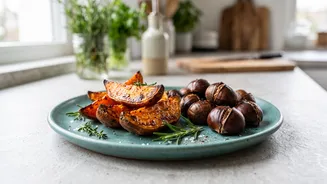






As the weather cools, two seasonal favourites appear on our plates: the humble sweet potato and the festive chestnut. Both offer a comforting, slightly sweet flavour, but for the calorie-conscious, which is the smarter choice? The answer isn't simple.
The Initial Calorie Clash
On a gram-for-gram basis, the difference is stark. Roasted chestnuts are significantly more calorie-dense than sweet potatoes. A 100-gram serving of roasted chestnuts contains roughly 245 calories, whereas the same amount of baked sweet potato has only about 90 calories. Chestnuts pack more protein and fat, but they are primarily carbohydrates, much like sweet potatoes. At first glance, the sweet potato seems like the clear winner for anyone looking to manage their calorie intake.
Serving Size Is Everything
Here is where the comparison gets complicated. No one typically eats just a handful of sweet potato, nor do they eat an entire plate of chestnuts. A standard serving of sweet potato is one medium-sized tuber, which, when baked, comes out to around 100 to 115 calories. In contrast, a typical serving of chestnuts is a small handful of about five or six nuts. That portion of chestnuts contains roughly 80-90 calories. Suddenly, as a snack, chestnuts look much more competitive. The danger lies in mindlessly eating chestnuts from a bag, where calories can quickly add up. A cup of roasted chestnuts can easily exceed 350 calories, far more than a single sweet potato.
How Cooking Changes the Game
The way you prepare these foods dramatically alters their caloric and nutritional profile. For sweet potatoes, boiling results in the lowest calorie count per 100 grams (around 76 calories) because the potato absorbs water. Baking concentrates the starches and sugars by removing moisture, increasing the calorie density to 90 calories per 100 grams. Of course, adding butter, brown sugar, or marshmallows can send the calorie count soaring. Chestnuts are usually roasted, which doesn't change their calorie content significantly. However, if you buy them preserved in syrup or use them in sugary desserts, their health profile changes entirely. The key is to enjoy both as close to their natural state as possible.
Beyond Calories: A Nutritional Deep Dive
A food's value isn't just in its calories. Sweet potatoes are nutritional powerhouses, most famous for their incredible vitamin A content; a single medium sweet potato can provide over 100% of your daily needs. They are also a great source of fiber and potassium. Chestnuts have a unique profile among nuts. They are lower in fat and higher in starchy carbohydrates and are the only nut to contain a significant amount of Vitamin C. They also provide B vitamins, copper, and manganese. When it comes to blood sugar, boiled sweet potatoes have a lower glycemic index (GI) than baked ones. Chestnuts, despite their carbs, have a low GI of around 54, making them a good option for sustained energy.
The Verdict: Which One Should You Choose?
There is no single 'better' option—it all depends on your goal. For a filling, nutrient-dense base for a meal or a substantial side dish, a baked sweet potato is an excellent, low-calorie choice. Its high fiber and water content promote a feeling of fullness. For a festive, portioncontrolled snack that provides slowrelease energy, a small handful of roasted chestnuts is a fantastic option. The trick is mindfulness. Treat the sweet potato as part of a meal and the chestnuts as a measured snack. Both are healthy, whole foods that can easily fit into a balanced diet when you pay attention to how you prepare them and how much you eat.