






The Universe’s Oldest Echo
Imagine being able to see the universe as it was just 380,000 years after the Big Bang. That’s essentially what the Cosmic Microwave Background (CMB) allows scientists to do. Often called the 'oldest light in the universe', the CMB is a faint afterglow
of radiation that fills all of space. It’s a snapshot from a time when the cosmos was a hot, dense fog of plasma. As the universe expanded and cooled, this fog cleared, allowing photons (particles of light) to travel freely for the first time. Those very photons, stretched and cooled over 13.8 billion years into microwaves, are what our telescopes detect today as the CMB.
What Is This Cosmic 'Twist'?
As this ancient light journeyed across the cosmos, it became polarized, meaning its waves started vibrating in a preferred direction. Scientists now have hints that this polarization didn't stay fixed. Instead, it may have rotated slightly along its path. This hypothetical phenomenon is known as cosmic birefringence. Think of it as if space itself has a subtle optical property, like a sugar solution or a crystal, that can twist the orientation of light as it passes through. Detecting such a twist would mean that the universe has a preferred 'handedness', a violation of a fundamental principle called parity symmetry, which states that the laws of physics should be the same for an object and its mirror image. A confirmed discovery of cosmic birefringence would be a dramatic signal of physics beyond our current Standard Model.
A Clue to Cosmic Mysteries
The search for this cosmic twist is not just an academic curiosity; it could unlock answers to some of the biggest questions in physics. The Standard Model has been incredibly successful, but it leaves major gaps, failing to explain dark matter and dark energy, which together make up about 95% of the universe's energy density. Some theories suggest that cosmic birefringence could be caused by interactions with a hypothetical field of exotic, ultra-light particles, such as axions. These particles are candidates for dark matter, and detecting their influence on the CMB would open a brand new window into the 'dark' sector of the universe. It could also provide crucial clues about the nature of dark energy, the mysterious force driving the accelerated expansion of the cosmos.
The Challenge of a Faint Signal
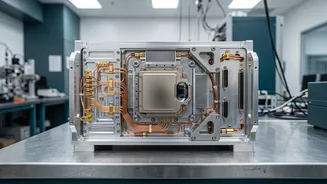
Finding reliable evidence is an immense challenge. The expected rotation is incredibly small, perhaps only a fraction of a degree. The biggest problem is distinguishing a true cosmic signal from instrumental errors. A tiny, systematic misalignment in a telescope's polarization detectors can create a false signal that perfectly mimics cosmic birefringence. Another major hurdle is contamination from our own Milky Way galaxy. Polarized light from galactic dust can interfere with the faint CMB signal, making it difficult to isolate the cosmological effect. Scientists are therefore developing sophisticated methods to calibrate their instruments with extreme precision and to filter out this foreground noise, often by comparing data from multiple experiments and frequencies.
Telescopes on the Case
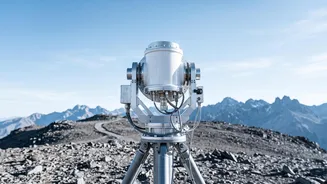
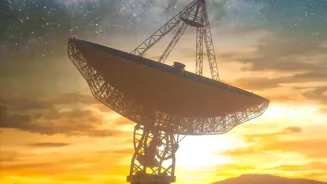
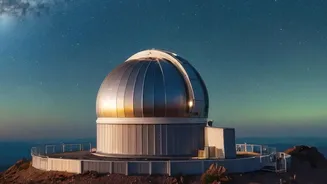
A global effort is underway to hunt for this signal with unprecedented accuracy. Data from past missions like the European Space Agency's Planck satellite and ground-based experiments like the Atacama Cosmology Telescope (ACT) and the South Pole Telescope have provided tantalizing hints of a small rotation, but not yet conclusive proof. Now, a new generation of even more sensitive instruments is joining the search. The Simons Observatory, under construction in Chile's Atacama Desert, and the future CMB-S4 experiment are designed to map the polarized CMB sky with incredible precision. These experiments, along with others, will significantly improve the constraints on the rotation angle, potentially confirming its existence or setting stringent limits that would rule out many theoretical models.