




A Prime Location in Space
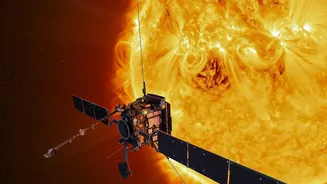
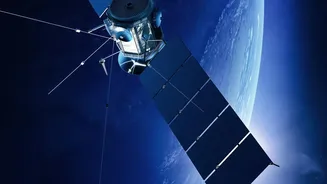
Imagine a place in space where the gravitational pull of the Sun and the Earth cancel each other out, allowing a spacecraft to 'hover' with minimal effort. That is a Lagrange point, and Aditya-L1 is currently stationed at the first one, L1, about 1.5
million kilometres from Earth. This specific location is a game-changer for solar science. Unlike satellites in orbit around Earth, which have the planet periodically blocking their view, Aditya-L1 has an uninterrupted, 24/7 line of sight to the Sun. This continuous observation is crucial for understanding solar phenomena that evolve rapidly. Reaching this point was a monumental feat of orbital mechanics for ISRO, marking a new chapter in India’s space exploration journey. From this stable platform, the spacecraft can act as an early warning system, observing solar events and the outflow of particles long before they reach our planet.
Decoding the Solar Wind
So, what exactly is this "solar wind" that Aditya-L1 is studying? It's a continuous stream of charged particles—mostly electrons and protons—ejected from the Sun's corona. This wind travels through the solar system at speeds up to 900 km/s. While invisible, its effects are profound. Its interaction with Earth's magnetic field creates the beautiful auroras. However, strong bursts, known as coronal mass ejections (CMEs), can damage satellites, disrupt communications, overload power grids, and endanger astronauts. Understanding its speed, temperature, and density is crucial for predicting 'space weather'.
The Instruments on the Job
Aditya-L1 is equipped with seven instruments to map these solar dynamics. Key among them for studying the solar wind are the Aditya Solar wind Particle Experiment (ASPEX) and the Plasma Analyser Package for Aditya (PAPA). These are in-situ instruments, meaning they directly measure the particles flowing past the spacecraft. ASPEX analyses protons and heavier ions, examining their direction and energy. PAPA focuses on electrons and their properties. By collecting data directly at L1, scientists get a detailed picture of the solar wind before it’s distorted by Earth's magnetosphere, providing a clean, unfiltered look at the material flowing from the Sun.
Early Insights and Future Goals
While the mission is still in its operational phase, ISRO confirms the instruments are performing well and transmitting valuable data. The initial phase involved calibration and observing the 'quiet' solar wind to establish a baseline. The spacecraft is already monitoring fluctuations in particle flow and has captured data from significant solar events like flares and CMEs. The ultimate goal is to use this data to develop more accurate models for space weather prediction. By understanding the precursors to major events, we could get warnings hours in advance. This would give satellite operators and grid managers time to take protective measures, safeguarding our technological infrastructure.
Why This Matters for India and the World
Aditya-L1 is a strategic asset. For India, it represents a significant leap in its space capabilities, placing ISRO among an elite group of agencies with observatories at L1. The data will fuel domestic research and will also be shared with the global scientific community. As India expands its satellite constellations for communication and navigation (NavIC), protecting these assets from space weather is a national priority. Aditya-L1 provides an independent capability to monitor solar activity, reducing reliance on data from other countries and strengthening our resilience in an era where space is critical for economic growth and national security.