





For decades, we have understood the universe to be about 13.8 billion years old. But what if it were nearly twice that age? A new study offers support for a model that pushes the cosmic clock back to 26.7 billion years, all to solve a modern cosmic mystery.
A Universe Twice as Old?
The standard model of cosmology, known as the Lambda-CDM model, has been remarkably successful, painting a picture of a 13.8 billion-year-old universe dominated by mysterious dark matter and dark energy. However, a researcher from the University of Ottawa, Adjunct Professor Rajendra Gupta, has put forth a challenging alternative. His model suggests the universe is actually 26.7 billion years old. This isn't just a random guess; it's a calculated proposal aimed at solving a nagging problem that has emerged from our best observations of the early cosmos.
The ‘Impossible' Early Galaxy Problem
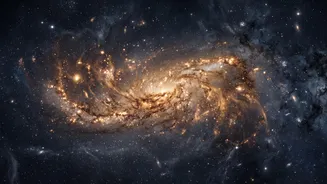
The challenge comes from NASA's James Webb Space Telescope (JWST). As it peered into the dawn of time, it discovered galaxies that were surprisingly mature and massive. According to the standard 13.8 billion-year timeline, these galaxies existed just a few hundred million years after the Big Bang. This presented a puzzle: how could such complex structures form so quickly? This 'impossible early galaxy problem' has led some scientists to question if our fundamental understanding of the universe's timeline is correct. Gupta’s model suggests these galaxies aren't impossibly evolved; they simply had much more time to develop.
Blending Old and New Ideas
Gupta's model is a hybrid, referred to as the CCC+TL model. It revives and combines two older, unconventional ideas. The first is 'Tired Light' (TL), a concept first proposed by astronomer Fritz Zwicky in 1929. It suggests that as light travels across billions of light-years, it naturally loses energy, making it appear redder. This redshift is usually attributed entirely to the expansion of space. The second part is 'Covarying Coupling Constants' (CCC), which proposes that the fundamental forces of nature might change over cosmic time. By combining these ideas, the redshift we observe in distant galaxies is reinterpreted as a mix of cosmic expansion and tired light, which mathematically stretches the universe's age.
How It Changes the Picture
If the CCC+TL model is correct, it doesn’t just solve the early galaxy problem. It could also reinterpret the need for dark matter and dark energy, which together are thought to make up 95% of the cosmos but have never been directly detected. Gupta's model suggests that the effects we attribute to these mysterious substances might instead be explained by the evolving forces of nature and the physics of tired light. In this older universe, Cosmic Dawn—the period when the first stars and galaxies formed—would have occurred around 4.6 billion years after the Big Bang, not a mere 300 million. This vast expanse of extra time makes those 'impossible' galaxies seem much more predictable.
Awaiting Scientific Consensus
It is crucial to understand that this is a provocative and unconventional theory. While papers by Gupta and his collaborators have been published in peer-reviewed journals like the Monthly Notices of the Royal Astronomical Society, the CCC+TL model is far from being accepted by mainstream cosmology. The Lambda-CDM model remains the scientific consensus because it successfully explains a wide range of observations, from the cosmic microwave background to the large-scale structure of the universe. Some analyses have already pointed out potential inconsistencies between the CCC+TL model and other cosmological data. This new theory represents a fascinating 'what if', but it faces a high bar to overturn decades of established science.