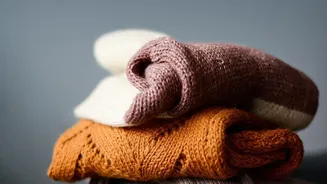






A beautiful woollen sweater is a winter wardrobe staple, but the fear of shrinking it in the wash is real. The secret to keeping your woollens soft and perfectly shaped lies in one place: the care label. Let's break down what it all means.
Why Wool Needs Special Attention
Wool is a natural
animal fibre composed of proteins. Unlike cotton or synthetic fabrics, wool fibres have a unique structure with tiny, overlapping scales. When exposed to the wrong combination of heat, moisture, and agitation, these scales can lock together, causing the garment to felt and shrink permanently. This is why you can't just toss your woollens in a normal wash cycle. Wool is also naturally antibacterial and odour-resistant, meaning it requires less frequent washing than other materials. Often, simply airing out a wool garment is enough to refresh it.
Decoding the Care Label: Your Washing Guide
Those hieroglyphic-like symbols are your most reliable guide to proper care. The most important symbol for wool is the washtub. A number inside the tub indicates the maximum water temperature in Celsius, which should almost always be 30°C or 40°C for wool. A hand symbol over the tub means 'hand wash only'. A tub with an 'X' through it means 'do not wash' and the item should be professionally dry-cleaned. Pay close attention to the bars underneath the tub: one bar means a gentle machine cycle, while two bars signify a very delicate or wool-specific cycle with minimal agitation. Forgetting these bars is a common way people accidentally felt their sweaters.
Hand-Washing: The Safest Method
When in doubt, hand-washing is the gentlest and most reliable way to clean wool. Start by filling a basin with lukewarm water (around 30°C) and adding a small amount of a pH-neutral, wool-specific detergent. Turn your garment inside out, submerge it, and let it soak for about 10 minutes. Gently squeeze the suds through the fabric; never rub, twist, or wring it, as this can cause stretching and felting. Rinse thoroughly, first in lukewarm water and then in cool water, until all the detergent is gone. Some modern wool detergents are 'no-rinse', which can further reduce handling.
Using a Washing Machine for Wool
Many modern wool garments are labelled as machine-washable, thanks to advances in both textiles and washing machines. If the care label permits, use your machine's dedicated wool, delicate, or handwash cycle. These cycles use cold water, low agitation, and a slow or minimal spin speed to mimic the gentleness of handwashing. To be extra safe, turn the garment inside out and place it in a mesh laundry bag to protect it from snagging. Never overload the machine; the drum should be no more than one third full to allow the garment to move freely without friction.
Choosing the Right Detergent
Standard laundry detergents can be too harsh for wool, as their enzymes and alkaline pH can strip the natural oils (lanolin) from the fibres, leaving them brittle and prone to damage. Always opt for a mild, pH neutral detergent specifically formulated for wool or delicates. Products like Woolite, Eucalan, or others labelled as 'wool wash' are excellent choices. Some even contain lanolin to help condition and soften the fibres with each wash. In a pinch, a small amount of baby shampoo can also work.
The Crucial Steps : Drying and Storing
How you dry wool is just as important as how you wash it. Never put a wool garment in a tumble dryer unless the care label explicitly allows it with a wool safe setting. Heat from a dryer is a primary cause of shrinkage. Also , never hang a wet wool sweater , as the weight of the water will stretch the fibres and ruin its shape . The correct method is to gently squeeze out excess water ( do not wring ! ) , then lay the garment flat on a clean , dry towel . Roll the towel and garment together to absorb more moisture , then unroll and lay it flat on a drying rack or another dry towel , away from direct sunlight or heat . For long term storage , always fold your clean woollens ; hanging can cause stretching at the shoulders . Store them in a cool , dry place with natural moth repellents like cedar or lavender .